

.parent {
display: inline; position: relative; line-height: 30px; float: left; color: #82be41;
}
.parent a{
margin: 10px;color: #82be41;text-decoration: none;
}
.parent:hover > ul {
display:block;position:absolute;
}
.child {
display: none;
}
.child li {
line-height: 30px;width:115%;text-align:left;
}
.child li a{
color: #82be41;
}
ul{
list-style: none;margin: 0;padding: 0px; min-width:10em;text-align: center;float: right; font-weight: 550;
}
ul ul ul{
left: 100%;top: 0;margin-left:1px;
}
li:hover {
background-color: white;
}
.parent li:hover {
background-color: white;
}
.expand{
font-size:10px;float:right;margin-right:5px;
}
.parent a p{
display: inline; margin: 10px;color: #6e706b;text-decoration: none;
}
Sustainability in the Tourism Industry
written by Jaclyn Yost | July 13, 2020

Pre COVID-19, international hospitality and tourism was receiving the most positive growth since the worldwide economic crisis of 2009. In fact, tourist receipts reached up to 1.8 billion international tourism arrivals in 2018; increasing over 6% from the previous year.
Airlines, restaurants, tour companies, accommodations, amongst others, are examples of tourism businesses that fall into this particular international sector — making up for 10.4% of all global economic activity and providing 1 in every 10 jobs worldwide. Without a doubt, the sector is a major international industry, and according to the United Nations World Tourism Organization’s (UNWTO) long-term forecast, this growth is only expected to continue. The high presence of tourism proves that it is one of the most necessary sectors for global economic development and job creation, as well as being a key driver in the development, well-being, and prosperity of ever-increasing destination locations. Yet, whilst many positive aspects can arise from the field, there has been controversy over the negative stressors that can be imposed on the environment, host communities, and host countries. This has been directly linked to “mass-tourism” or “over-tourism” — which is the term used to describe the millions and millions of more travelers each and every year; coming in at great volumes and relying on local infrastructures.

Java, Indonesia. 📷Jaclyn Yost
With such a large reach, it is obvious that the overall industry has the potential to be socially and environmentally detrimental if not managed correctly. Recognizing this, consumers, governments, non-governmental organizations, stakeholders and so on, have put escalated pressure on communities, destinations, and tourism-related companies to conform to more sustainable methods. Taking sustainable tourism development into perspective, the field is effectively meant to holistically offset the negative side effects of mass tourism and positively reach across various focus areas. If applied correctly, sustainable tourism can support inclusive and sustainable economic growth; social inclusiveness, employment, and poverty reduction; resource efficiency, environmental protection, and climate change; cultural values, diversity, and heritage; and mutual understanding, peace, and security; acting as a channel to bring out good social, cultural, and economic aspects, whilst removing the negative environmental and social impacts. Moreover, in the midst of the climate crisis, the global sustainability movement has gained immense momentum. A major instigator of this growing awareness was due to the UN Intergovernmental Panel on Climate Change (IPCC)’s 2018 report warning to limit global warming to 1.5°C.
Research suggests that sustainability is becoming a defining issue due to rising populations and increasingly scarce resources, which in return will be problematic for hospitality and tourism environments. Some researchers have even referenced the travel industry and the climate situation by stating that a clear understanding of the issues surrounding climate change, global warming, air and water pollution, ozone depletion, deforestation, the loss of biodiversity, and global poverty is essential for every future manager to consider. Therefore, alluding to the fact that sustainability plans need to be embedded within the industry in an attempt to mitigate relative issues.
Furthermore, aside from being “the right thing to do”, from a business standpoint, adopting green practices and a sustainability strategy can bring cost savings, competitive advantage, customer loyalty, awards and recognitions, increased brand value, employee retention, regulatory compliance, and risk management.
Consumer Trends
Taking into consideration the significant environmental impact, the hospitality field has been unable to extricate themselves from this eco-friendly trend due to their large international presence. It has even been suggested by researchers that, as society as a whole tends to progress towards the adoption of more sustainable lifestyles, sustainable innovations in accommodations will become imperative in order to ensure their long-term economic growth and to maintain their place within the market.
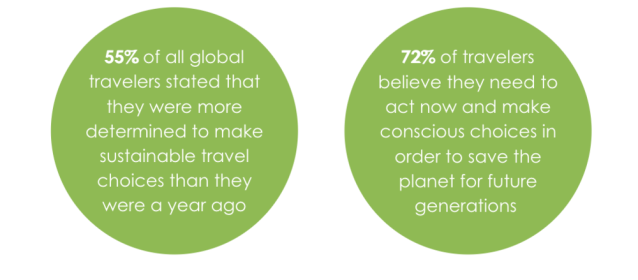
Furthermore, it can be seen that the number of travelers putting green accommodation practices as a top priority has grown significantly. In fact, according to Booking.com’s 2019 Annual ‘Sustainable Travel Report Key Findings’––
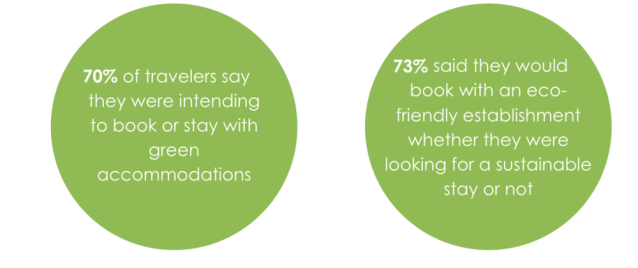
It also showed that eco-accommodations are growing in popularity. So much so that––
And because of the hospitality sector’s strong focus in customer service, the demand for green accommodations from the market environment has caused establishments from all around the world to quickly react to this change and seek green practices in order to satisfy consumers and stakeholders; especially as the overall impression of environmentally friendly practices has been found to positively increase and induce higher customer loyalty.
Eco-Accommodations
But what exactly qualifies as a green accommodation? With over 300 certification bodies within the hospitality & tourism industry with differentiating guidelines and standardizations, it seems that the general concept of a green accommodation is to reduce their energy and water consumption, provide local and non-durable goods, and take into account the emissions that are released into the air, water, and soil… all while finding an appropriate balance between visitor satisfaction, green projects, and effective operations.
Furthermore, it is important to note that the concept of sustainability expands beyond just the environment. Officially, it should also take into account management practices, as well as social, cultural, and economic matters too. Meaning, sustainable accommodations should also consider economic growth goals, social justice, intergenerational equity, and cross cultural understanding between local individuals and guests; in addition to their environmental policies. Especially as an accommodation is strongly connected to the local destination, it should be heavily rooted to assist the surrounding community in all positive ways. In fact, it is thought to believe that the social and economic dimensions of sustainable accommodation management are becoming significantly more important in affecting a consumer’s satisfaction, outside of purely environmental concerns.
*
With sustainability coming to the forefront of the minds of businesses and consumers, we’re hoping to see an increase in sustainable travel and tourism. ecomadic is here to support your journey and connect you with credible & responsible businesses.
meet the author

Jaclyn Yost
Jaclyn is the founder of ecomadic and editor of The Sustainable Seed. She is conscious creative passionate about shedding light on environmental and social sustainability issues through travel.
 ecomadic