
.parent {
display: inline; position: relative; line-height: 30px; float: left; color: #82be41;
}
.parent a{
margin: 10px;color: #82be41;text-decoration: none;
}
.parent:hover > ul {
display:block;position:absolute;
}
.child {
display: none;
}
.child li {
line-height: 30px;width:115%;text-align:left;
}
.child li a{
color: #82be41;
}
ul{
list-style: none;margin: 0;padding: 0px; min-width:10em;text-align: center;float: right; font-weight: 550;
}
ul ul ul{
left: 100%;top: 0;margin-left:1px;
}
li:hover {
background-color: white;
}
.parent li:hover {
background-color: white;
}
.expand{
font-size:10px;float:right;margin-right:5px;
}
.parent a p{
display: inline; margin: 10px;color: #6e706b;text-decoration: none;
}
Cultural Authenticity & The Crazy Horse Memorial: What does it actually mean to be culturally aware?
written by Meagan McRoberts | November 2, 2020
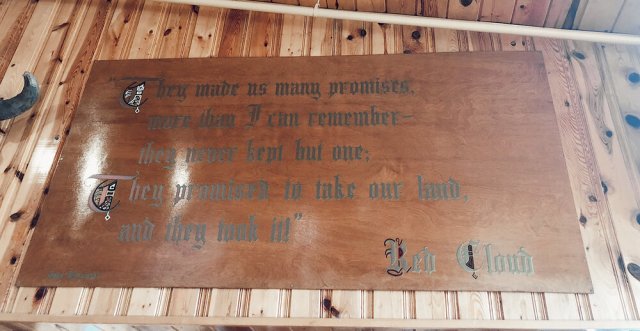
“They made us many promises, more than I can remember – they never kept but one: They promised to take our land, and they took it.”
Red Cloud
Reading this quote standing in the museum of the Crazy Horse Memorial, surrounded by Native American art, traditional clothing, and crafts in glass boxes or hanging on the walls, I felt its power with a twisted knot in my stomach. I’d spent the past two days driving through the Black Hills. I’d felt the spiritualness of the land, seen wildlife considered sacred to natives, and pondered what it would be like to have no phone and navigate the world under a blanket of stars. Facing the facts of America’s past while staying in a town named Custer, sent me into a heaviness and a reflective state, mourning a loss I will never be able to fully understand as a young white woman of European descent.
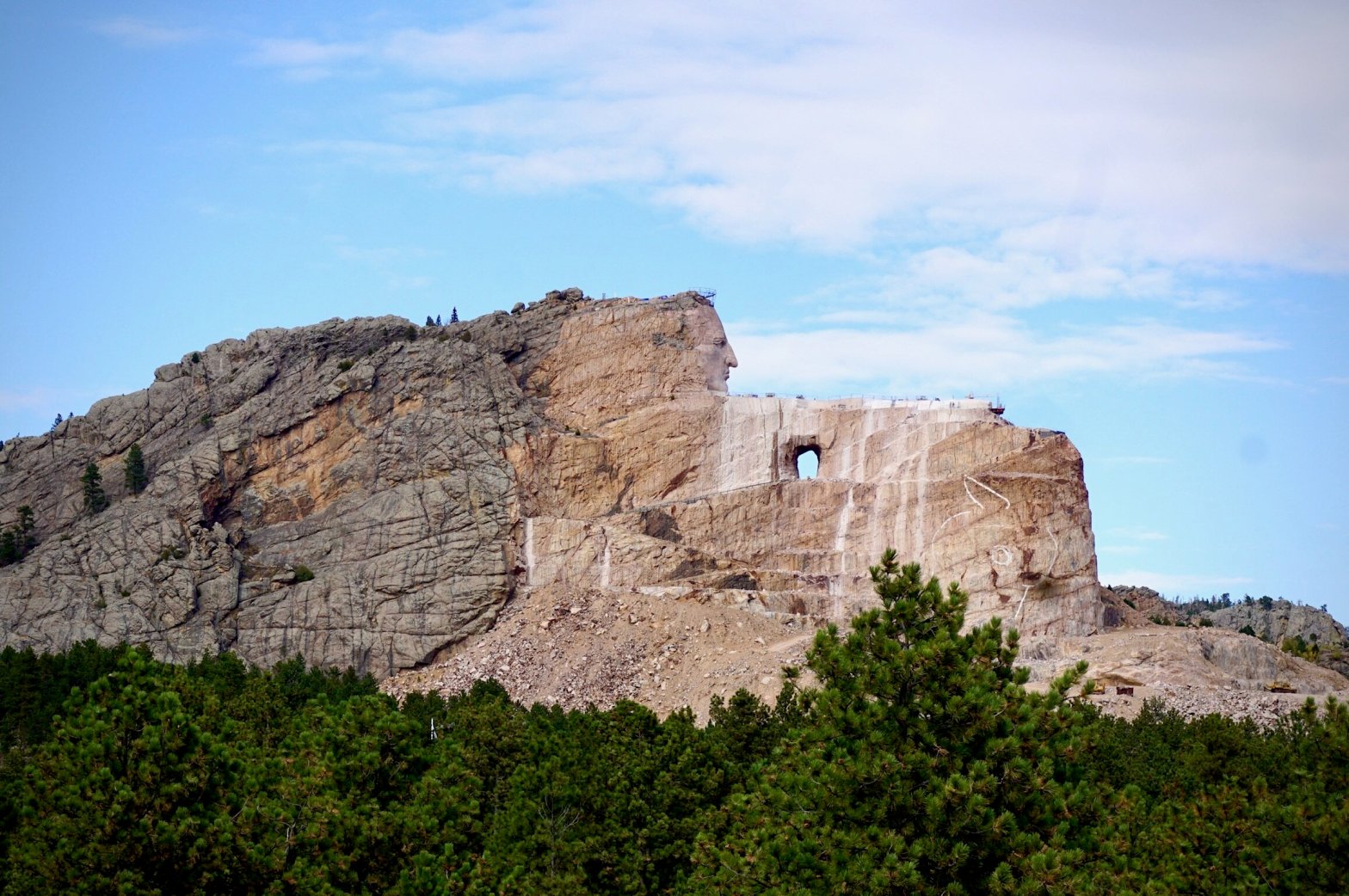
Tasunke Witko, also known as Crazy Horse is a Native American War Hero. He was an Oglala Lakota famous for defeating Custer at the Battle of Little Bighorn and never giving in to the white man. He fought against the American government as they tried to confine native people to reservations. Crazy Horse was killed at Fort Robinson, Nebraska on September 5, 1877. In 1948, construction began on a sculpture in South Dakota to honor him.
📷 Jaclyn Yost
Inside the museum of the Crazy Horse Memorial, there’s a short documentary on the history of the mountain carving, its creators, and the Native people it aims to represent and celebrate. The film mentions that in 1939, a Lakota elder – Henry Standing Bear wrote to Korczak Ziolkowski, a sculptor who had worked briefly on Mt. Rushmore, to say that there should be a memorial in response to Rushmore—something that would show the white world “that the red man had great heroes, too.”
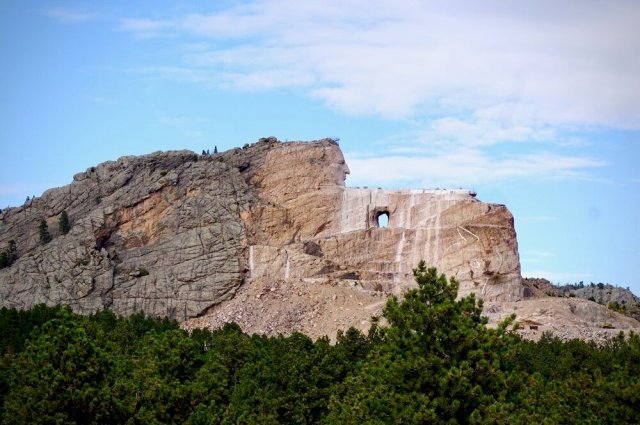
Sculptor Korczak Ziółkowski began working, and thought it would take 30 years to build but ended up dedicating his life to the project. It’s still far from finished and will be the largest sculpture in the world when completed. The Ziółkowski family now works to oversee the project, run tours, and operate and manage the museum, and cultural center.
I watched the film, wandered throughout the museum, gazed at the sculpture, and browsed the gift shop. I left and said aloud, “Did it feel like that was more about the Ziółkowski family than the Native Americans?”
In the Lakota language, the Black Hills (He Sapa or Paha Sapa) can be translated as “the heart of everything that is.” In a 2019 article in the New Yorker by Brooke Jarvis, she writes about speaking to a ninety-nine-year-old elder in the Sicongu Rosebud Sioux Tribe named Marie Brush Breaker-Randall who told her that the mountains are “the foundation of the Lakota Nation.” She also spoke with Nick Tilsen, an Oglala and activist who said Crazy Horse was a “man who fought his entire life” to protect the Black Hills and to “literally blow up a mountain on these sacred lands feels like a massive insult to what he actually stood for.”
With more research, knowledge, and conscious thought about Native American history, I suppose I could’ve drawn this conclusion myself. Maybe a ginormous mountain carving similar to Mount Rushmore isn’t how all Native Americans would prefer to honor one of their leaders? And support from a few Native Amercians doesn’t mean support from all.
One of the core pillars of sustainable tourism is –
‘to protect the socio-cultural authenticity of host communities and destinations through respectful cross and inter-cultural understanding, and the conservation of cultural heritage and values – both built and living.’
While that may sound simple enough, the Crazy Horse Memorial’s mission is “to protect & preserve the culture, tradition, & living heritage of the North American Indians.”
That sounds like sustainable tourism, right?
The memorial also created The Indian Museum of North America, The Native American Educational and Cultural Center, and contributes to The Indian University of North America. The memorial does not take money from the government.
But where do we draw the line? How do we know what to support? How do sustainable tourism and experiencing Native American culture intersect?
I am not the most qualified person to answer this question so I began searching for Native American opinion and information on the matter.
I came across Native American Tazbah Rose Chavez’s article on ‘How To Honor The Native American Population While Traveling America’. It’s worth a full read but I’ll summarize the main takeaways that apply to being a responsible traveler, although these can all be practiced in your home town.
Chavez says, ‘know where you are’. You can use this link to type in any city and it will pull up the tribal territory you are in, the language and treaties. This will make you a more informed traveler and increase Indigenous visibility. She writes about how ignoring these things contributes more to their erasure.
Another piece of advice is to explore cultural centers and look into who funds and operates them so you can be sure to ‘learn the authentic narrative of a people and place.’ Chavez does recommend visiting the Smithsonian’s National Museum of the American Indian in DC.
As always, respect the land. We can learn a lot about the land in our home country from Native American culture and history including how to preserve it and protect for years to come. Lastly, it’s important to buy authentic souvenirs. Ask where things are made and be sure it supports Native people.
While it’s not always obvious what’s sustainable, we can take the time to educate ourselves about the places we visit. It’s a constant journey and learning process, and just because I work in the sustainable tourism industry doesn’t mean it requires any less work from my end. Considering America’s past, it takes work to travel sustainably. I am not perfect and will make mistakes. In fact, I am happy to be called out for them. I can thank the Crazy Horse Memorial for sparking my interest in understanding more about Native American culture and at ecomadic, we will continue this conversation while recognizing our privilege and bias.
I find it’s easy to get caught up if a business has plastic straws, vegan options, and if they market themselves as ‘green’ or ‘eco-friendly’ and while these things are important in making a difference– it’s essential to shift our focus and include the socio-cultural aspect of sustainability as well. Being ‘culturally aware’ in your own country may not be something you think of but educating yourself, amplifying authentic voices and perspectives, and being more inclusive can help us to use tourism as a force for good.
meet the author

Meagan McRoberts
Meagan holds an MA in Creative Writing and is passionate about travel and sustainable living. When she’s not working, she’s either in the ocean, on her yoga mat, or in transit to somewhere new.
 ecomadic