
.parent {
display: inline; position: relative; line-height: 30px; float: left; color: #82be41;
}
.parent a{
margin: 10px;color: #82be41;text-decoration: none;
}
.parent:hover > ul {
display:block;position:absolute;
}
.child {
display: none;
}
.child li {
line-height: 30px;width:115%;text-align:left;
}
.child li a{
color: #82be41;
}
ul{
list-style: none;margin: 0;padding: 0px; min-width:10em;text-align: center;float: right; font-weight: 550;
}
ul ul ul{
left: 100%;top: 0;margin-left:1px;
}
li:hover {
background-color: white;
}
.parent li:hover {
background-color: white;
}
.expand{
font-size:10px;float:right;margin-right:5px;
}
.parent a p{
display: inline; margin: 10px;color: #6e706b;text-decoration: none;
}
A Threat to Our Nation, A Threat to Our Planet
written by Priyanka Surio & Jaclyn Yost | January 16, 2021
Attack on the U.S. Capitol
Last week, the world witnessed a deplorable act of sedition from self-proclaimed Trump supporters, who raided the U.S. Capitol. Beyond who they are supporting, it is the “what” they are supporting that represents the root of the problem.
White supremacy, hatred, racism.
A disregard for public health during COVID-19.
A disbelief of climate change as an existential threat to our planet.
Americans were faced with the truth of both their action and inaction in the face of poor and troubling leadership. Leadership that has set us behind in our fight for equality and for the planet.
Nonetheless, I hold onto hope as we begin 2021 for the promise of new leadership in President Joe Biden and Vice President Kamala Devis Harris. The new administration has already begun their plans for healing a nation divided and addressing climate change with a team and plan to boot.
Yet the biggest critique from skeptics is that the effects of climate change are not proven or not a priority compared with other pressing issues such as the economy or our global pandemic.
Exploring Climate Change with an Open Mind
To address this, I encourage open-mindedness as you explore what might happen as natural disasters and the resulting consequences of an increasingly warming planet play out. A global natural disaster at the scale of what we’ve seen from Hurricanes in our U.S. territories and island nations would devastate our economy, likely our power grid, and our livelihood.
Beyond the scientific evidence that’s been gathered on global warming, universities and research institutions, like Yale’s School of the Environment, have further explored their impact on natural disasters. Evidence collected shows that human-caused global warming is making our storms and fires more destructive. What does more destruction look like? Stronger winds, worse storm surges, flooding, drier land prone to fires, and displacement for people who lose their homes or livelihoods as a result.
Climate Change Around the World
The fact is, much of this is already happening at an increasingly rapid pace all over the world, including at home in America, and abroad.
Climate change can be seen in Miami, FL where sea level rise is so pressing that Miami Beach has been referred to as the “ground zero of climate change”. Experts predict that by 2100, nearly a third of the current population will be displaced as a large part of the city will be uninhabitable and partially underwater. Similar sea level rise predictions can also be applied to Venice, Italy and the Maldives where higher and higher tides point to the eventual devastation of entire cities and countries being submerged underwater.
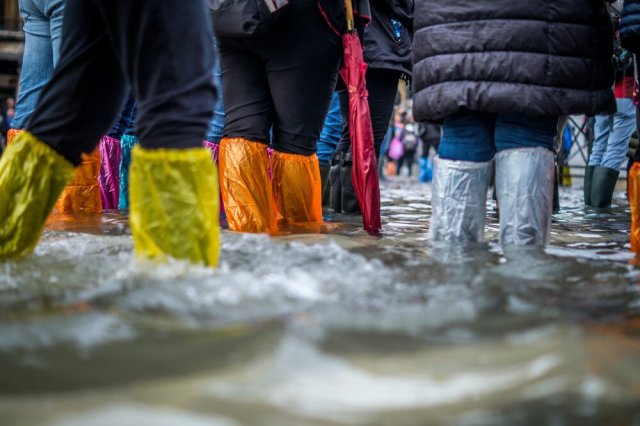
Flooding in Venice, Italy.
Climate change can also be seen in wildfires. From the bushfire crisis in Australia to wildfires on the West Coast of the U.S. all the way to the Amazon rainforest, extreme temperatures, severe droughts, and human activity have combined to create optimal fire-prone conditions. Climate change can also be linked to the floods that wreak havoc on the American midwest and across the world in Bangladesh, damaging the environment and scattering communities, oftentimes leaving them with nowhere to go.
It is worth mentioning that these examples are just a tip of the iceberg. While climate change and its effects may look different across the globe – from both an environmental and social point of view – climate change affects us all and it is a collective issue.
Effective Leadership
One of the most important strides towards collaborative change begins with good leadership; leaders who recognize when innovation and adaptation are necessary to break through the status quo.
And the status quo we must break. During the Trump administration, budget cuts were proposed and enacted for any climate change related initiatives. As a result, we were largely unprepared for the amount of destruction and ensuing costs associated with these natural disasters.
These could have been avoided had leadership heeded the warning of scientists and of the communities most impacted by these disasters.
One approach that world leaders could consider when preparing to prevent or mitigate the impacts of climate change includes that of building smart cities and communities. In using this approach, both resilience and giving back mindsets come into play as we learn and grow from past mistakes to create better solutions for our future on this Earth.
World leaders that exhibit these mindsets have been exploring design solutions that enable easier response and mitigation. For example, Finland uses sensor technology to enable lights on the roads and sidewalks during intense snow storms or blizzards so that people can find their way home. Another example includes the recent development of science and technology parks in Asia and the Pacific. Science and technology parks merge research institutes, innovation centers, land or the use of green spaces, and creative architecture to facilitate an environment that spurs ideation and creation. To learn more, visit the Smart City Hub, which includes practices from various cities of the future.
Looking to the Future
A brighter, more sustainable future can be reached and achieved through new leadership in America, global work with other countries and world leaders, and collective societal support and accountability. Climate change is one of the most defining issues of our time and it will require mitigation and adaptation response efforts by us all in order to save the future of humanity and our planet.
meet the authors

Priyanka Surio – Activist, Director & Author of ‘Third Culture Kids of the World’
Priyanka is a multinational – with Indian-Hungarian-American roots – who grew up in Mulberry, Florida. She belongs to a global community of adventurers, that she refers to as the world’s third culture kids; representing members of a multi-cultural, transcontinental, and intersectional class. Through her work, she also advocates for a more inclusive and sustainable future. She has been to 40 countries and 44 out of the 50 states. While she enjoys being a nomad and seeing the world, she has also found a sense of home deeply rooted in Washington DC.
Jaclyn Yost
Jaclyn is the founder of ecomadic and editor of The Sustainable Seed. She is conscious creative passionate about shedding light on environmental and social sustainability issues through travel.
 ecomadic