


.parent {
display: inline; position: relative; line-height: 30px; float: left; color: #82be41;
}
.parent a{
margin: 10px;color: #82be41;text-decoration: none;
}
.parent:hover > ul {
display:block;position:absolute;
}
.child {
display: none;
}
.child li {
line-height: 30px;width:115%;text-align:left;
}
.child li a{
color: #82be41;
}
ul{
list-style: none;margin: 0;padding: 0px; min-width:10em;text-align: center;float: right; font-weight: 550;
}
ul ul ul{
left: 100%;top: 0;margin-left:1px;
}
li:hover {
background-color: white;
}
.parent li:hover {
background-color: white;
}
.expand{
font-size:10px;float:right;margin-right:5px;
}
.parent a p{
display: inline; margin: 10px;color: #6e706b;text-decoration: none;
}
An Overview of Biden’s Climate Plan
written by Raven Steele | January 19, 2021
Designed by: Jaclyn Yost & Raven Steele
From rising sea levels, shrinking ice sheets, and polar bears being vulnerable to extinction, climate change is rapidly growing and we are already starting to see the effects it has on the world. In the United States alone, massive forest fires, flooding in the midwest, unsafe drinking water, amongst others, indicate that climate change is all around us and affects us all.
What is Climate Change?
Climate change is defined as a long-term change in average weather patterns that are accustomed to Earth’s local, regional, and global climates. These drastic changes in seasonal temperatures and disproportionate weather patterns are primarily linked to human activity; in particular, fossil fuel burning.
President-elect Joe Biden has enacted a climate plan to combat the seemingly ever-growing climate crisis. Global warming and climate change was first spotlighted by mainstream media as a growing problem in the 1980s, however it hasn’t been until now where we have seen aggressive policy being proposed by U.S. administration to move into a greener future.
While the climate crisis is not expected to be fixed overnight, in order to be successful, this gradual process needs to be collectively supported by the new administration, businesses, and organizations, and held accountable by society. Hence why educating ourselves on these issues and policies are important to promote action.
The Biden Plan Explained
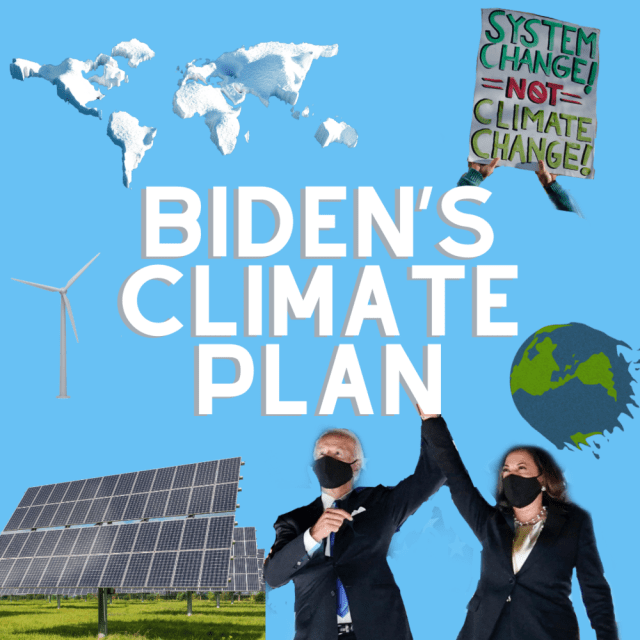
Unlike the Trump administration – who reversed over 100 environmental rules – the Biden-Harris party are promising big transitions into sustainable solutions. For example…
“President-Elect Joe Biden will become a leader that will ensure that the U.S. will achieve a 100% clean energy economy and net-zero emissions by no later than 2050.”
Source: https://joebiden.com
The big claim above means that he will prioritize creating a balance between the greenhouse gas emissions that we emit and the amount we remove from the atmosphere. This can be done by focusing on things like solar panels, wind turbines, and electric charging stations.
In addition, Biden has ensured to also make climate change a national security priority; therefore promising to rebuild the nation and make sure that buildings, roads, bridges, and transportation can withstand the effects of climate change.
Through large investments in clean energy research and innovation, The Biden Climate Plan will push the development, affordability, and accessibility of Carbon Capture, Utilization, and Storage (CCUS) technologies – capturing CO2 emissions and preventing them from being released into the atmosphere.
Plans Enacted Once in Office
Climate change is a global challenge that needs to be tackled head on by leaders around the world. Biden has promised that on his first day in office he plans to sign executive orders to fast track combating environmental injustice.
One of which is rejoining the Paris Agreement, which the U.S. was briefly removed from in 2020 by the Trump Administration. As a recap, the Paris Agreement is a legally binding international treaty created in 2015 that includes commitments from nearly 200 countries to cut their climate pollution and combat the environmental issues. Rejoining would be a significant step to getting back to working with other nations to battle the climate crisis.
Furthermore, while energy-efficient plans are costly, to stay true to their green vision, the Biden-Harris party has pledged that they will not accept any form of donations from oil, gas, and coal corporations. Instead, they will fund the climate plan by reversing tax cuts given to fossil fuel companies by President Trump.
Helping the People
The Biden Climate Plan calls for a worldwide ban on fossil fuel assistance. Climate change and global warming doesn’t only affect our wildlife and greenery. Black, Indigenous, and people of color (BIPOC) and fence line communities have been linked to suffer at the hands of giant fossil fuel companies that harm the environment by poisoning the surrounding air and water.
Communities across America are experiencing issues like food deserts and water contamination, directly linked to the fossil fuel industry. The neighborhoods directly affected by climate change will have the opportunity to work with the administration to ensure safer communities; working to ensure that low-income and BIPOC communities will be amongst the first to benefit from the new aged “green” economy.
To establish a smooth transition, Biden has promised to provide sustainable clean energy jobs, fair wages, benefits, and worker protection for those who currently work in the gas, oil, and airline industries. Furthermore, to further prevent community health defects, public companies will now be required to disclose any climate risks in their business operations.
Our Future
To survive on a habitable planet, climate change will need to be addressed through aggressive policy in order to decarbonize the U.S properly by 2050. What we choose to do within the next decade can be crucial to the ending of global warming. A collaborative effort to reach net-zero emissions would mean a bright future not only for ourselves but for generations to come.
To read more on Biden’s Plan for a Clean Energy Revolution and Environmental Justice, follow the link here.
meet the author

Raven Perkins Steele
Raven is currently a college student residing in Charlotte, NC. Her interests include traveling and exploring the world through different lenses. Having a passport from before the age of walking has instilled the value of different cultures as a part of her identity. She is passionate about spreading awareness on political and social issues in the United States and abroad.
 ecomadic
Great article!!
LikeLike
Very enlightening and interesting.
LikeLike