
.parent {
display: inline; position: relative; line-height: 30px; float: left; color: #82be41;
}
.parent a{
margin: 10px;color: #82be41;text-decoration: none;
}
.parent:hover > ul {
display:block;position:absolute;
}
.child {
display: none;
}
.child li {
line-height: 30px;width:115%;text-align:left;
}
.child li a{
color: #82be41;
}
ul{
list-style: none;margin: 0;padding: 0px; min-width:10em;text-align: center;float: right; font-weight: 550;
}
ul ul ul{
left: 100%;top: 0;margin-left:1px;
}
li:hover {
background-color: white;
}
.parent li:hover {
background-color: white;
}
.expand{
font-size:10px;float:right;margin-right:5px;
}
.parent a p{
display: inline; margin: 10px;color: #6e706b;text-decoration: none;
}
Opinion: Breaking Down Biden’s Environmental Justice Plan
written by Josefina Artigas | January 27, 2021
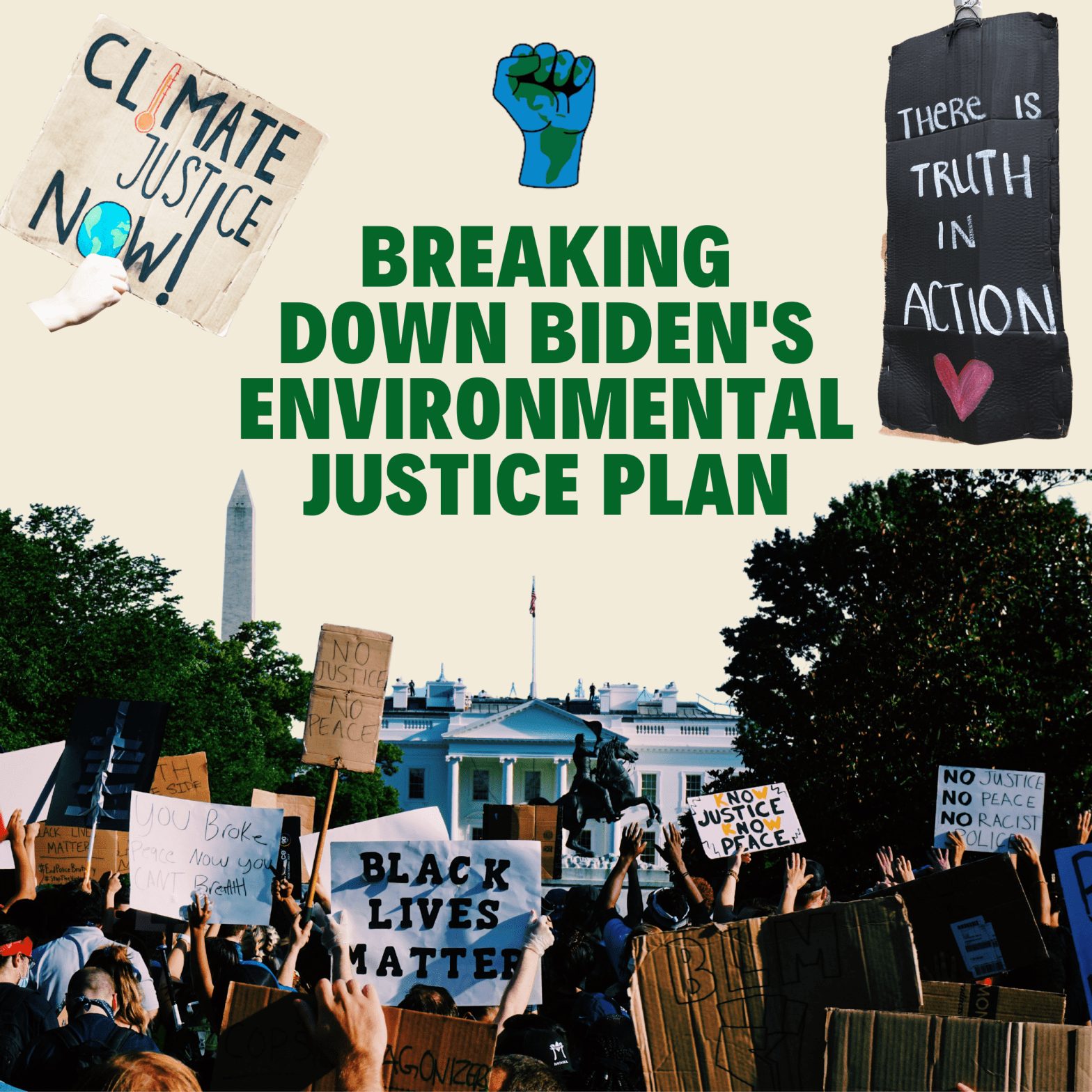
Photos & Design: Jaclyn Yost
Already barely into the new presidency, we are seeing words turning into action regarding the environment. On day one, President Biden signed critical environmental executive orders to rejoin the Paris agreement, revoked the Keystone XL Pipeline permit, and plans to review regulation rollbacks established by the Trump administration. During his campaign, Biden made big promises regarding climate change and emphasized the importance of helping communities most affected by environmental risks and corporate pollution. What can we be expecting from Biden’s Plan To Secure Environmental Justice and Equitable Economic Opportunity?
The Importance of Environmental Justice
Biden has placed importance on environmental justice within his climate change plan as a result of the COVID-19 pandemic and its devastating effect on communities of color. Those who are the most affected by climate change are not those who benefit from the destruction of the environment. The climate crisis has emerged due to the legacies of imperialism, colonialism, the continuous extraction of resources, and capitalism. We have neglected how these confluent ideologies have stripped our planet and significant portions of the population for too long.
None of this happened by accident. There are countless examples of how systemic oppression has led to those most marginalized suffering the most. Our legislation has led to the concentration of subordinate groups into neighborhoods where they face the worst environmental pollution and risks from big corporations looking to place their facilities in areas with little regulation. Although the plan has been celebrated this past week as a victory, the Biden administration has missed the mark in critical areas.
A Quick Breakdown of the Plan
The Biden administration plans to use an “all-of-government approach” to remediate the harm caused to marginalized groups. They plan to do this by revising the 1994 Executive Order 12989, which addressed the disproportionate effect on people of color and low-income communities from unchecked corporate power and governmental negligence. Biden also plans to institute new departments such as the Environmental Justice Division within the Justice Department and revitalize the EPA External Civil Rights Compliance Office (The EPA has reported the lowest number of criminal anti-pollution cases ever during the Trump administration).
A central tenet of the plan is the pledge to make decisions driven by data and science, bringing a sigh of relief for many environmental activists. Biden is planning to do so by reinvigorating the EPA’S EJSCREEN tool to help locate the groups who are the most disposed to environmental risks and pollution. Additionally, he has appointed influential environmental experts to lead both the EPA and the White House Council on Environmental Quality. Michael Regan could be the first Black man to head the EPA. He has been an environmental regulator for the EPA under the Clinton administration and is currently the secretary of the North Carolina Department of Environmental Quality. Brenda Mallory would be the first Black person to run the CEQ. She has been a lawyer for the EPA, worked at the CEQ under the Obama administration, and is widely considered a top expert on environmental policy. We should always be skeptical of the new administration. Still, it’s thrilling to see that governmental agencies will finally start to include BIPOC – Black, Indigenous, and People of Color – in positions of power.
Biden has also promised to invest 40% of the overall benefits from investments into clean energy, transportation, and housing into disadvantaged communities. The Biden administration will identify these communities through the use of the newly updated screening tool. Additionally, the Biden plan sets out to address the link between climate change and public health in the face of the COVID-19 pandemic. He plans to establish a new ‘Task Force to Decrease Risk of Climate Change to Children, the Elderly, People with Disabilities, and the Vulnerable’ and establish an ‘Office of Climate Change and Health Equity at HHS.’
What is Concerning About the Plan?
Climate change is a global challenge that needs to be tackled head on by leaders around the world. Biden has promised that on his first day in office he plans to sign executive orders to fast track combating environmental injustice.
One of which is rejoining the Paris Agreement, which the U.S. was briefly removed from in 2020 by the Trump Administration. As a recap, the Paris Agreement is a legally binding international treaty created in 2015 that includes commitments from nearly 200 countries to cut their climate pollution and combat the environmental issues. Rejoining would be a significant step to getting back to working with other nations to battle the climate crisis.
Furthermore, while energy-efficient plans are costly, to stay true to their green vision, the Biden-Harris party has pledged that they will not accept any form of donations from oil, gas, and coal corporations. Instead, they will fund the climate plan by reversing tax cuts given to fossil fuel companies by President Trump.
Looking Forward
The Biden Administration is trying to keep up with the environmental promises they’ve made throughout the campaign. The Environmental Justice Plan is most definitely ambitious and sets an unprecedented focus on people of color and low-income communities who have faced uneven climate change consequences. But there are some glaring deficiencies. Biden has neglected to include how gender and racial inequality also plays into environmental justice, leaving a massive hole in the plan. Without addressing these fundamental concerns, we might be set back in our progress.
Still, there are some things we can keep doing to hold the new administration to their promises and to ensure that what we demand includes those who have been silenced for too long. Solidarity can help amplify our voices. Keep on marching on the streets. Keep calling out elected officials who are not acting with the best interest of the public in mind. Be consistent, and keep that same energy moving forward.
Just because Biden won the election does not mean we’re done with our work.
To read more on Biden’s Plan for a Clean Energy Revolution and Environmental Justice, follow the link here.
meet the author

Josefina Artigas
Josefina is a content writer at ecomadic. They hold a BS in Biochemistry and a minor in sociology. Their interests include cooking, anime, and coding. They are passionate about the intersection of sustainability and social justice.
 ecomadic