

.parent {
display: inline; position: relative; line-height: 30px; float: left; color: #82be41;
}
.parent a{
margin: 10px;color: #82be41;text-decoration: none;
}
.parent:hover > ul {
display:block;position:absolute;
}
.child {
display: none;
}
.child li {
line-height: 30px;width:115%;text-align:left;
}
.child li a{
color: #82be41;
}
ul{
list-style: none;margin: 0;padding: 0px; min-width:10em;text-align: center;float: right; font-weight: 550;
}
ul ul ul{
left: 100%;top: 0;margin-left:1px;
}
li:hover {
background-color: white;
}
.parent li:hover {
background-color: white;
}
.expand{
font-size:10px;float:right;margin-right:5px;
}
.parent a p{
display: inline; margin: 10px;color: #6e706b;text-decoration: none;
}
Opinion: Eco-Tourism or Ego-Tourism?
written by Giuliana Gentile | January 26, 2021
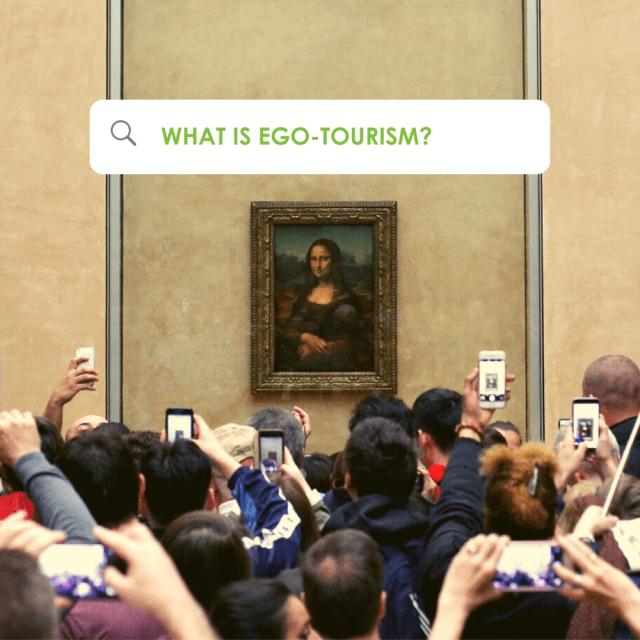
Social media has drastically affected the way we travel. According to recent data, Facebook and Instagram are two of the top three sources of travel inspiration among millenials. Documenting our travels on social media has become an integral part of the experience itself, and sometimes taking the perfect picture of a beautiful landscape is more important than seeing it in person. But do our tags on Instagram benefit the wonderful destinations we brag about in our posts? Or are we simply feeding our narcissistic desire of showing the world how cool we are?
The Impact of Social Media on Tourism
When human beings stepped on the Moon for the first time in history, the whole world watched them proudly plant their flag to let everyone know they’ve been there.
Nowadays, with social media we come to know new places through the lenses of other people’s cameras; so when we post our staged picture with the perfect outfit in some “exotic” location, we tag that place, we plant our little flag to let everyone know we’ve been there.
Recent research shows that 84% of millennials and 73% of non-millennials are ‘likely’ or ‘very likely’ to plan a trip based on someone else’s vacation photos or social media updates.
Theoretically there’s no harm in that: by posting our travel pictures we receive recognition from our followers, and the locality gains more attention, therefore more tourists, therefore more money.
But unfortunately, money is not always the final and only outcome. Popularity can be a double edged sword, and lead to just as much harm as it can increase profits.
The public exposure that social media offers has made it extremely difficult to find unknown locations or unexplored paths, while the once moderately touristic spots have become unbearably crowded.
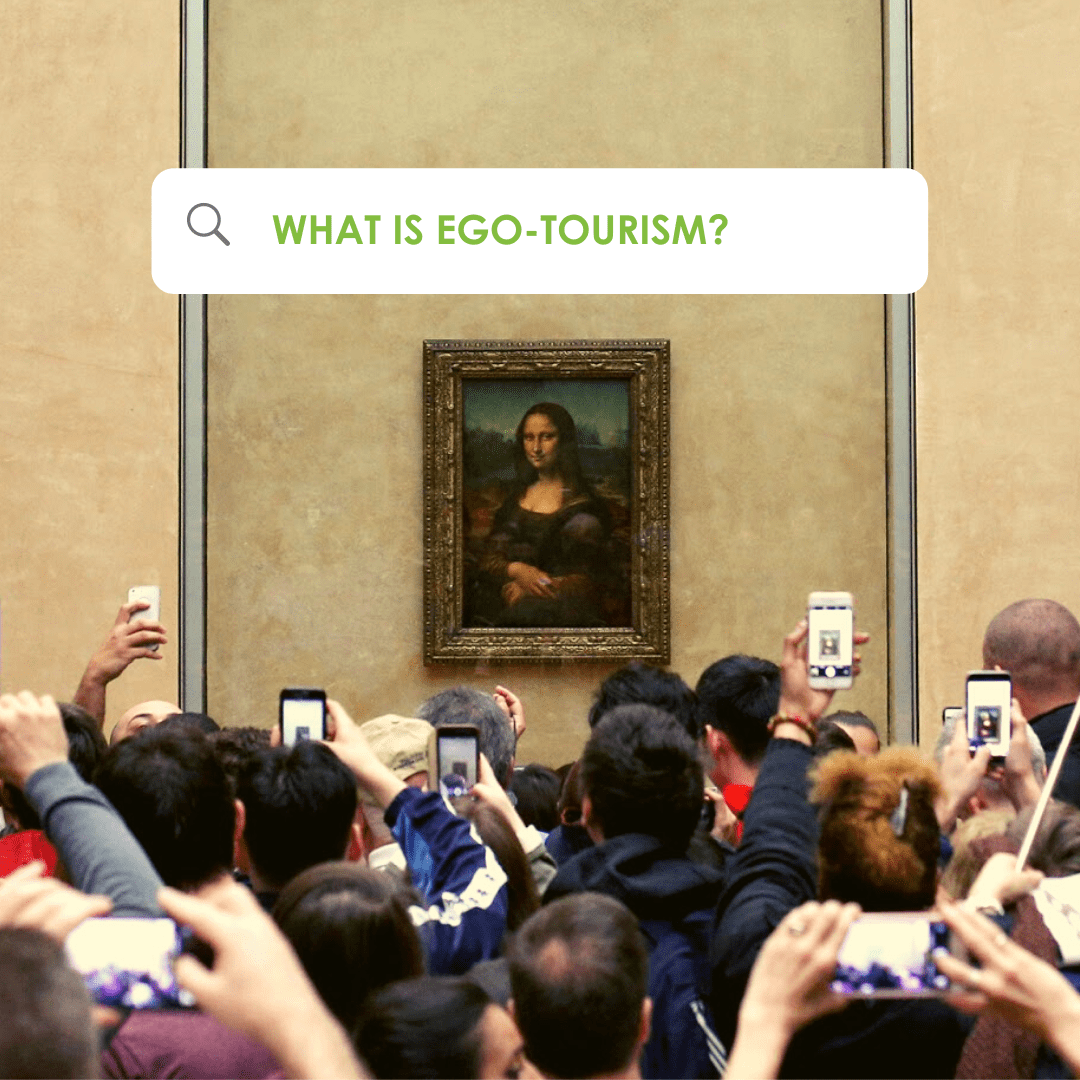
What is Ego-Tourism?
This eagerness of taking pictures and selfies in the locations we visit developed into a phenomenon labeled as “ego-tourism”.
There’s a variety of definitions for this term, but most of them define an ego-tourist as someone who takes an adventurous trip, not for the experience itself, but for the bragging rights of having been there.
In this regard, Dr. Stanislav Ivanov gives a simple explanation:
“People travel, because they want to be talked about (need of recognition, esteem), because they want to be associated with a specific group of people (belongingness) or because they want to prove to themselves that they are capable of doing something or better than the others (self-actualization). The main motivator is, however, the need of recognition.”
In other words, our virtual social interactions – the likes and comments we receive – appagate our narcissistic desire for other people’s validation. So we’re brought to believe…
“If you didn’t post it on Instagram, did it even happen?”
Consequently, when traveling, this egocentric behavior implies the complete disregard for the actual location and the people who live it.
The Consequences of our Actions
The overflowing mass of tourists who visit the once pristine spots they saw on social media, in most cases causes considerable damage to the environment where these places are located. Research shows that one of the most affected locations are the islands and beach related destinations, where the negative effects of the human presence are immediately visible.
One example of this can be seen on the west coast of Sicily, Italy. San Vito Lo Capo, one of the most popular beaches in the area, attracts a large number of tourists every year due to the “instagram-able” white sands and blue waters.
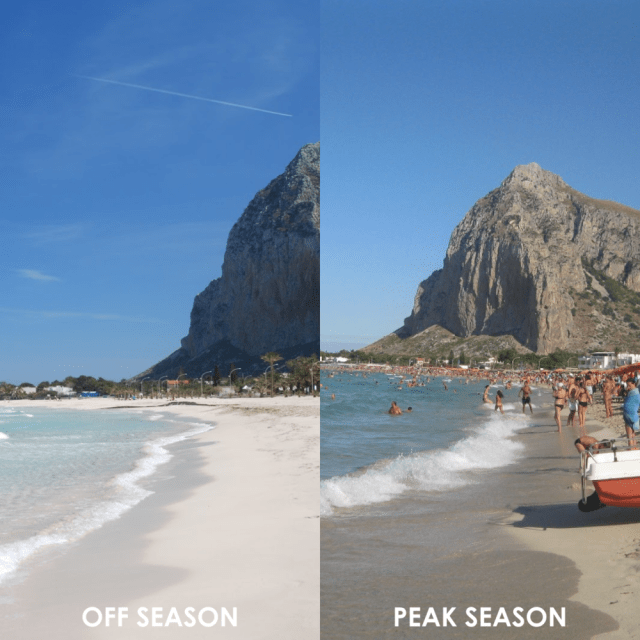
During the peak season in the summer, thousands of umbrellas and chairs cover those white sands entirely, and the water near the shore turns into a greenish turbid color.
The biggest and so far inevitable consequence of overcrowding in San Vito is the constellation of trash left behind by its visitors – plastic bottles, cigarettes, wraps, and containers can be easily spotted all over the sand and underwater.
This drastic mutation of the landscape is due to the enormous increase of human presence all in the same period of time. San Vito is a small town of around 4,700 people which, according to statistical data, has already hosted more than 140,000 tourists in a single year, the majority visiting during the peak season of July and August.
One of the reasons behind the change of color of the water, and a rather disgusting one, is the urine of thousands of people concentrated on the shore, combined with the residue of sunscreen that gets released in the sea.
Unfortunately, San Vito is only one of the many places disrespected by its visitors. Which leads to the question: is a pretty picture on Instagram worth it?
Ego-Tourism vs. Eco-Tourism
The disrespect and disregard for the environment, typical of ego-tourism, comes in direct contrast with eco-tourism; which is, by definition:
“Responsible travel to natural areas that conserves the environment and improves the wellbeing of local people.”.
Meaning, eco-tourism is meant to educate the travelers to care about their surroundings and respect the places they visit, having no negative impact on the environmental or socio-cultural aspects of a destination.
Traveling is supposed to make us feel better and is an opportunity for personal growth, so there’s nothing wrong with doing it for egocentric reasons. But when we plan our trips we face multiple choices that can really make a difference between being an ego-tourist instead of an eco-tourist.
Making selfish choices as a traveler often causes damage to the environment, the loss of cultural authenticity, and ends up barely benefiting the local community, which should be the goal in the first place. To put this into perspective, according to WWF, the revenue going back to the local economy with eco-tourism is 95%, while with “standard” all-inclusive package tours it goes as low as 20%.
So what can we do about it?
While we should document our travels – and, I believe that, it’s wonderful to publicly share our experiences so that others can be inspired to explore new places and new cultures. It is important that we stay conscientious of our actions to ensure our eco-tourist intentions do not become ego-tourist tendencies. Listed below are some tips to avoid just that:
-
Leave No Trace: always, always take your trash with you and carry it until you find a trash can (no matter how far it is, and even better if it’s recyclable). By bringing your own bag, you can make it easier for yourself, and you can even pick up other people’s trash. Not everyone is as mindful as you are, so help our planet and get your hands dirty… you can always wash them afterwards. Additionally, if you’d like to give an even bigger contribution, you can easily organize or participate in a cleanup! All you need is yourself, and your love for planet Earth.
-
Ditch the Toxic Sunscreen: read the label of your sunscreen before you buy it, some of them are made with natural ingredients and are also designed to be reef safe. See the Haereticus Environmental Laboratory’s comprehensive list for all potentially harmful ingredients.
*hint hint, some of the most toxic sunscreen brands include: Banana Boat, Coppertone & Hawaiian Tropic.
-
Don’t Choose Overcrowded Destinations: avoid traveling with numerous people and group tours (such as boat trips with more than 10 seats on board). Instead, travel by yourself or with a couple of other people; ask locals for directions; and hike, walk, or rent a bike to get around. If you absolutely must go to an overpopulated spot, avoid traveling in the peak season to miss the crowds. Therefore getting a much more authentic adventure.
-
Educate Yourself to Avoid Disrespectful Picture Taking: we all want to keep some beautiful memories from our travels, and it’s great to capture the landscapes we visit in the best way possible. However, we must always be mindful of the people around us and the place we are walking in. Asking ourselves questions like…
“Am I ruining the experience for someone else?”
“Am I disrespecting the culture?”
“Am I generating further overcrowding?”
“Am I causing damage to the environment?”
Want to learn more?
Overtourism: too much of a good thing – National Geographic
ECOTOURISM – EGOTOURISM? – Maija Bertule, Jens M. Kring, Lasse Degn, Qillaq Nielsen, Gerelmaa Gerelsaikhan
‘Ego travel’ – your guide to the narcissistic heart of modern holidaying – The Guardian
Targeting Moments of Need in the New Travel Landscape – amp agency
Paradise lost: World’s most beautiful places under threat of tourism – BBC News
Is Your Sunscreen Bad for the Planet? Here’s How to Choose an Ocean-Safe Formula – Vogue
meet the author

Giuliana Gentile
Giuliana was born and raised in Sicily (an Italian island in the middle of the Mediterranean Sea), since then she’s been moving around the world to meet new cultures and discover new places. She has a degree in Political, Social and International Sciences. During her studies she became passionate about environmental protection, gender equality, and cultural identity. She loves traveling, petting dogs on the street, and swimming underwater.
 ecomadic
That’s a great perspective of it. Most countries just focus on the money tourism brings, and forget the harm overtourism leaves behind for the local people to deal with (or not).
LikeLike
Really clever to point out this problem. It will become irreversibile if we don’t solve it in time.
LikeLike