
.parent {
display: inline; position: relative; line-height: 30px; float: left; color: #82be41;
}
.parent a{
margin: 10px;color: #82be41;text-decoration: none;
}
.parent:hover > ul {
display:block;position:absolute;
}
.child {
display: none;
}
.child li {
line-height: 30px;width:115%;text-align:left;
}
.child li a{
color: #82be41;
}
ul{
list-style: none;margin: 0;padding: 0px; min-width:10em;text-align: center;float: right; font-weight: 550;
}
ul ul ul{
left: 100%;top: 0;margin-left:1px;
}
li:hover {
background-color: white;
}
.parent li:hover {
background-color: white;
}
.expand{
font-size:10px;float:right;margin-right:5px;
}
.parent a p{
display: inline; margin: 10px;color: #6e706b;text-decoration: none;
}
Sustainable Trails: Connecting People With the Earth for Generations to Come
Written by Jennifer MacBain-Stephens | February 23, 2021
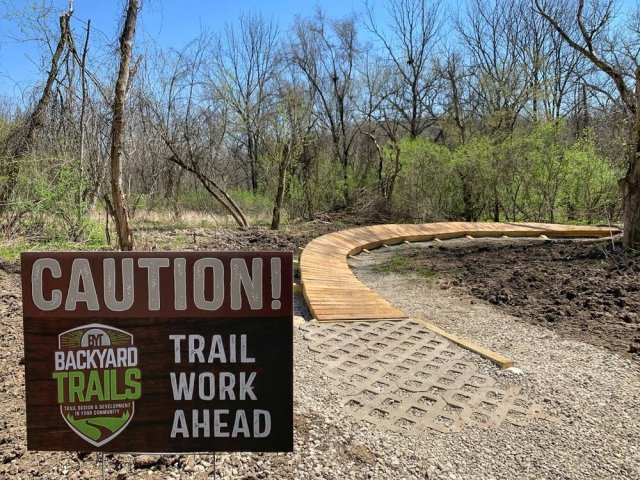
Source: BackYard Trails, LLC.
The trail you use the most is the most important trail in the world.
This is the tag-line of Backyard Trails, LLC, designing and building trails in your neighborhood, at the moment, in the Midwest.
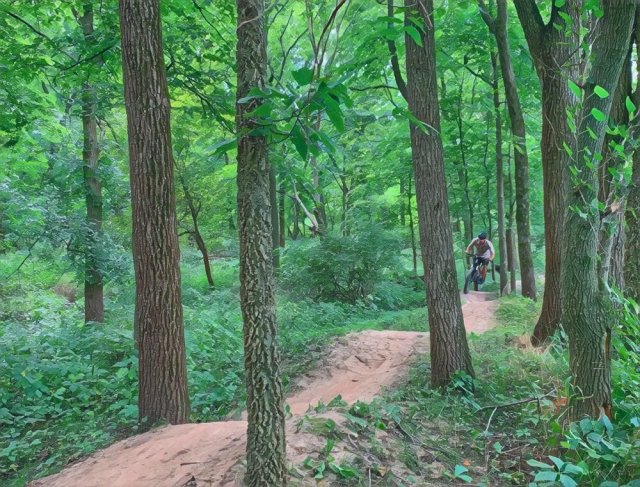
To clarify, these are not hard surface trails that sport dog walkers, rollerblades, and skateboard activity, we are talking about narrow, natural surface trails: where you get on your mountain bike and disappear around a bend at sunset under a tree canopy and the only sounds you hear are the wind and the birds.
Source: BackYard Trails, LLC.
It is an immersive experience, riding a mountain bike on a singletrack trail. Ken Barker, owner of BYT, says, “if we engage with nature, we are more likely to take care of nature.”
Taking it further, when asked about sustainability practices, Barker says: “sustainability is #1 when designing and building natural surface trails! It is of utmost importance to think like water, you don’t want mother nature washing your hard work away nor do you want the trail to end up in local rivers and streams. This is considered the physical sustainability of a trail. There are two other important forms of sustainability – social and economic.”
So how is this trail building company getting it done? It’s a lot of work to write up a proposal, get permission from an organization or city, measure and design out an interesting path in dirt, build technical features, test it out, battle the elements and unforeseen setbacks.
Drainage has to be figured out. Where will the rainfall go? You don’t want to ride in a swamp! What are the freeze/thaw soil cycles like? Rain for days sets you back. Machines fail. Natural disasters bring trees down in the work area.
Long story short, it is not for the faint of heart. Through perseverance, however, something artistic and beautiful is made.
For more background, a breakdown of recent projects by Backyard Trails where this forward thinking company reused materials and thought outside the box to create immersive, exhilarating trail experiences can be found below.
Flow
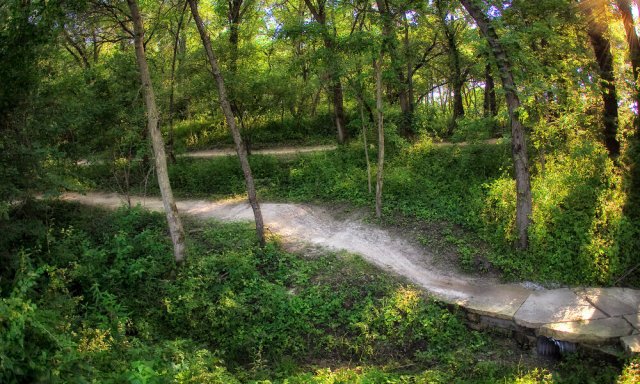
Coralville Creekside Park. Source: BackYard Trails, LLC.
Creekside Park consists of a Climbing Trail (which lets you flow to the bottom in a pretty effortless way, on super fun Flow Trail), an Intermediate Flow Trail, and Sand Crane (advanced trail). Barker designed these continuing dirt roller coasters with the aim of propelling the rider into a mental and physical state of blissful focus.
In psychology, a flow state, also known as being in the zone, is the state in which a person performing some activity is fully immersed in a feeling of energized focus, first described by Mihaly Csikszantmihalyi, a Hungarian-American psychologist, in 1975.
The Creekside trail system is basically a miniature bike park with mountain bike trails as well as a cyclocross course. The mountain bike trails focus on creating trail experiences for a wide range of riders in a relatively small and unused public park space. Described in more detail on Trailforks, the advanced trail, Sand Crane used large, flat Limestone rocks to pave the way up a steep hill that was too sandy to summit on a bike. These stones were discarded from landscaping projects in the city due to flaws and imperfections. Barker says “The city brought me soil, rocks, and timber that wasn’t being used. I used almost 100% of what they brought me.”
Limestone
Tucked away in a forest in Dubuque, Iowa, a green space called the Interstate Power Preserve, a trail called Circuit Breaker used beautiful chunks of limestone to challenge riders around curves and steep down hills. Barker says, “All rocks were located on site, when digging the trail I often had to move rocks, instead of discarding them I tried to use them to help make the trail surface more durable (which [also] makes it more sustainable) and provides the trail user with a different texture not typically found in the area.”
REI Philanthropy
Source: BackYard Trails, LLC.
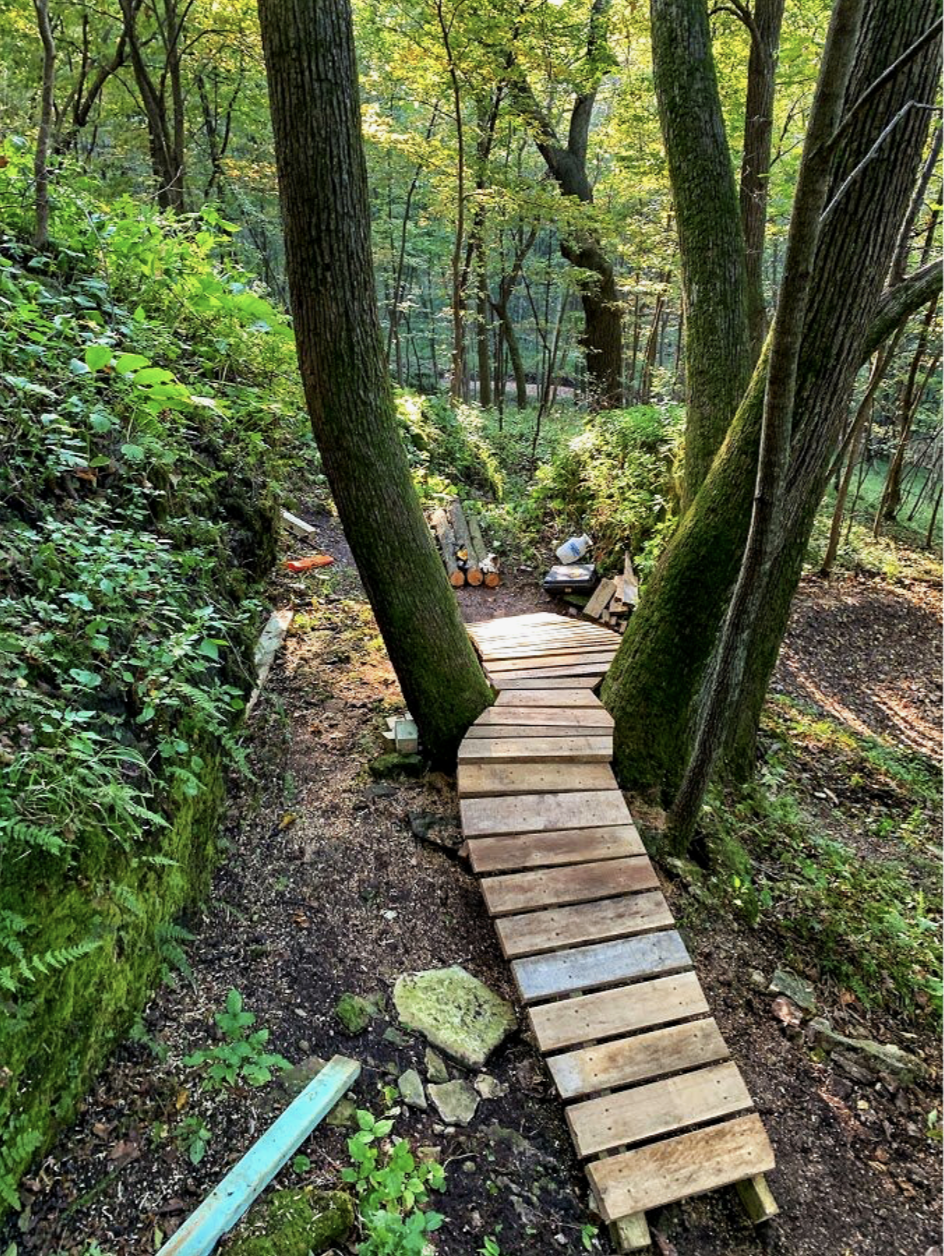
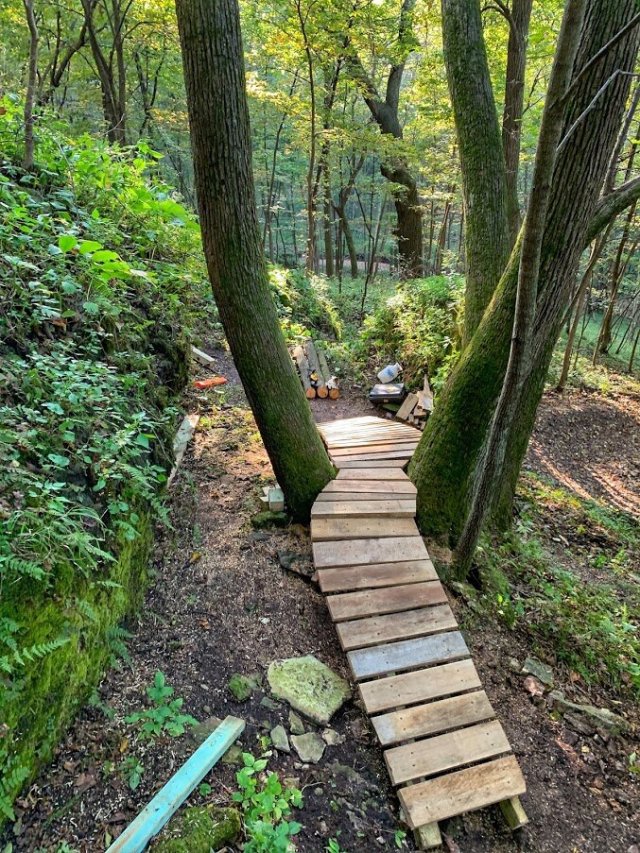
Ewing Park in Des Moines, Iowa. The Central Iowa Trail Association applied for a grant through the REI Co-op Philanthropy program which focuses on building healthier communities by getting them outside, investing in sustainable innovation projects, and striving to keep cities more wild by preserving green spaces. Backyard Trails was hired to create an advanced trail option: a curved wooden bridge over a swampy area on the land. The foundation of this turning boardwalk feature is made entirely of repurposed concrete from the city of Des Moines.
Repurposing a Landfill
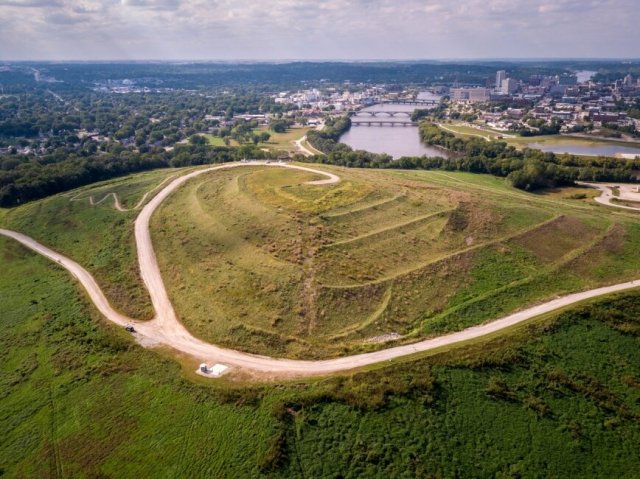
Mt. Trashmore in Cedar Rapids, Iowa: When this landfill closed for good in 2012, the Cedar Rapids Linn County Solid Waste Agency began to brainstorm how the site could be repurposed. Rising 950 feet above sea level and creating a stunning lookout point, Trashmore is an example of turning a closed landfill into a community asset. Built by a company in Colorado, and enjoyed by many during the riding season, BYT helped advocate for this project, trained agency staff on maintenance, and continues to complete upkeep and contract work on the site’s trails.
Source: HDR
Barker enthuses, “I would describe the project as a really beneficial use of otherwise unused land. The flow trail took some advocacy to be considered and was then developed in a similar manner to other recreational facilities (ball fields, playgrounds, etc.) Probably one of the coolest things about Mt. Trashmore, other than the view and trails, is that the facility is educational in nature – aiming to inform the public about waste management and the impacts on what we throw away.”
Trail School
A big part of trail design is what comes after. Volunteers need to be trained in maintaining these trails. People’s perception and knowledge of natural surface trails varies greatly, therefore education is an especially important aspect of creating and taking care of these sorts of trails. Doing it wrong affects all forms of sustainability – environmental, social, and economic – and avoiding pitfalls, especially permanent ones, is critical. In Mason City, Iowa, BYT created a community wide trail plan, taught a trail school, and plans to fulfill future builds in the area.
“Natural surface trails have always been around, and sustainable trail building practices really aren’t a new thing. However, the demand for this sort of trail experience has skyrocketed over the years, therefore it is important for those who wish to have these sorts of trail experience in their communities to plug into the development process and advocate for their creation,” says Barker.
Final Message
“Properly planned for, designed, and constructed natural surface singletrack trails and mountain bicycling facilities are environmentally, socially, and economically sustainable. The environmental sustainability of a trail asks and answers the question, what are the potential impacts of a trail on the landscape, and weighs this against the benefits provided by the trail. A socially sustainable trail provides visitors the opportunity to achieve their recreation objectives, while protecting land resources; increasing the capacity of the land for enjoyment while minimizing negative impacts.”
The National Parks Service defines a sustainable trail as one that:
1. Supports recreation today and for the future
2. Minimal wear on nearby ecosystems
3. Leaves dirt intact, allows vegetation to thrive
4. Requires proper construction from the start and continuing maintenance
When a trail is built, it could be there for a hundred years. Backyard Trails and other conscious businesses, do it right the first time, enabling us to savor our environment and the Earth.
To find out more:
Linn Area Mountain Bike Association (LAMBA)
United States Dept. of Agriculture: Trail Strategy
meet the author
Jennifer MacBain-Stephens
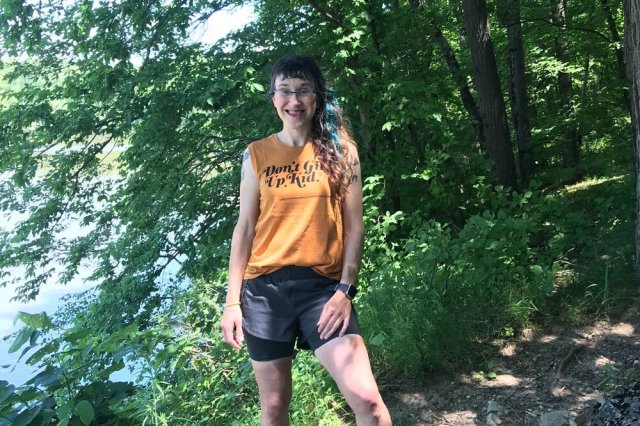
Jennifer MacBain-Stephens went to NYU’s Tisch School of the Arts and now lives in Iowa where she likes to rock climb, hike, and mountain bike. She is the author of four poetry collections and enjoys exploring how to blend creativity with nurturing the earth. She also hosts a free, monthly reading series sponsored by Iowa City Poetry called Today You Are Perfect.
Find her at: http://jennifermacbainstephens.com/.
 ecomadic