
.parent {
display: inline; position: relative; line-height: 30px; float: left; color: #82be41;
}
.parent a{
margin: 10px;color: #82be41;text-decoration: none;
}
.parent:hover > ul {
display:block;position:absolute;
}
.child {
display: none;
}
.child li {
line-height: 30px;width:115%;text-align:left;
}
.child li a{
color: #82be41;
}
ul{
list-style: none;margin: 0;padding: 0px; min-width:10em;text-align: center;float: right; font-weight: 550;
}
ul ul ul{
left: 100%;top: 0;margin-left:1px;
}
li:hover {
background-color: white;
}
.parent li:hover {
background-color: white;
}
.expand{
font-size:10px;float:right;margin-right:5px;
}
.parent a p{
display: inline; margin: 10px;color: #6e706b;text-decoration: none;
}
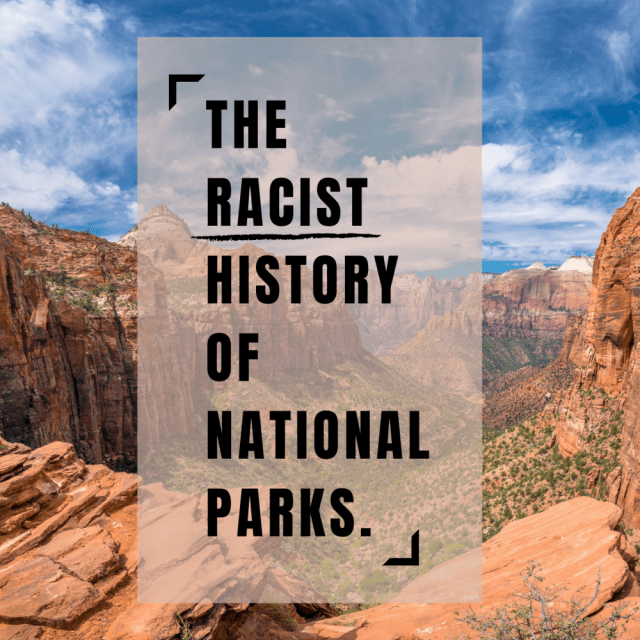
The Racist History of National Parks
written by Josefina Artigas |March 1, 2021
Design: Jaclyn Yost
Many have turned to National Parks throughout the pandemic to alleviate stress and have something exciting to do. Touted as ‘America’s Best Idea,’ the National Parks have seen a boom in visitation numbers as people seek ways to travel while staying relatively socially distant. Although the pandemic is hitting hard for almost everyone around the country, – especially people of color and low-income communities – visitation at National Parks is still predominantly white. Many factors come into play regarding low diversity in visitation numbers – including socio-economic access, cultural differences, discrimination, and historical erasure. To understand just how pervasive racial disparities are within access to National Parks, we need to revisit how they were established in the first place.
History of Conservation & National Parks
We can trace the modern U.S. environmental movement back to the 19th and early 20th centuries. Influential members such as Henry David Thoreau, John Muir, and Franklin D. Roosevelt advocated conserving the U.S. wilderness due to the destructive forces of expansion. This early conservation movement was instrumental in establishing the Wilderness Act of 1964, which sought to protect the natural environment for the American people. The act would prove influential in the establishment of National Parks across the nation.
What did the members of this early environmental movement have in common? Besides supporting indigenous people’s forceful and violent removal from their homes, they were white, affluent, and college-educated. The legislation stressed the importance of preserving land “in their natural condition” to “secure for present and future generations the benefits of wilderness.” At first glance, there doesn’t seem to be anything especially controversial. But upon a closer glance, it’s apparent that the legislation expressed only white people’s preferences and outlined who would realistically benefit under the law.
Impacts
The Wilderness Act of 1964 outlined what was considered “acceptable” activities within nature. The act only allowed activities that did not “disrupt nature,” such as hiking, camping, and research. Under this framework, those who had an intertwined relationship with nature for sustenance, shelter, and culture were considered unlawful. This meant that groups who for generations foraged, hunted, and fished in what are now federally protected lands lost all access to their means of life. It’s crucial to keep in mind that policies surrounding environmental protection have historically marginalized the lives of BIPOC folk.
Additionally, National Parks are where much of U.S. history is told today. A combination of historical erasure, violent dispossession, white-washing, and in some cases, complete omission have skewed the way history is recounted. Further, the legacies of legal and institutional segregation and violence against people of color in the form of lynchings and land dispossession contribute to why many don’t necessarily feel safe and welcomed at parks. Many report that they are discriminated against while navigating the outdoors, which negatively affects their experience in nature.
Another contributing factor is the low diversity of National Park employees at all levels. The agency relies on a seasonal workforce as a means to full-time employment. According to former National Park Service (NPS) director Jonathan Jarvis, the way that the agency hires its workers has created a system that makes it harder for people of color to seek full-time employment at the parks. Jarvis explained in an interview:
“In order to get one of those entry-level jobs in the service, you have to serve multiple seasons as a seasonal, which means you have to have some economic status in order to do that kind of job,” Jarvis said. “You end up with a middle-economic-class, college-educated, white feeder group because they’re available.”
– Jacobs & Hotakainen, 2020
Next Steps
Low diversity in visitation numbers should be of concern for several reasons. For one, it highlights the need for change to go beyond attracting a more diverse pool of visitors but rather make the outdoors a safer and welcoming space. Furthermore, it shows a gap in the people who are not actively included in efforts towards conservation. Subsequent action and support are needed to make the outdoors more accessible. Removing racial and discriminatory names, exploring historical narratives that differ from the mainstream, hiring more people of color in land management services, and considering historical practices outlawed are just the beginning.
Most importantly, we must ensure that future policy regarding federally protected lands and parks includes people of color in the dialogue. Often, public parks are built and structured around white preferences and priorities. To pass meaningful legislation, considering and including people of color in the will be instrumental moving forward. Janae Davis – an academic passionate about exploring ideas & practices that link environmental, environmental justice, and social justice movements – reminds us that:
“At a time when environmental problems that threaten our quality of life are exacerbated by political maneuvers which further endanger our ecosystems, the NPS cannot afford to alienate an increasingly diverse population. Policies established in times of extreme racial violence, such as the Wilderness Act, should be reassessed to address real concerns about the relationship between racial injustice and environmental protection.”
– Davis, 2019
For more information, check out:
Black Faces, Black Spaces: Rethinking African American Underrepresentation in Wildland Spaces and Outdoor Recreation – Janae Davis, 2019
Breaking Down the Lack of Diversity in Outdoor Spaces – Naomi Humphrey, 2020
For African Americans, Park Access Is About More Than Just Proximity – Brentin Mock, 2016
The Nature Gap – Center for American Progress, 2020
Why People of Color Often Feel Unsafe Outdoors – Amanda Machado, 2020
meet the author
Josefina Artigas
Josefina is a content writer at ecomadic. They hold a BS in Biochemistry and a minor in sociology. Their interests include cooking, anime, and coding. They are passionate about the intersection of sustainability and social justice.
 ecomadic