
.parent {
display: inline; position: relative; line-height: 30px; float: left; color: #82be41;
}
.parent a{
margin: 10px;color: #82be41;text-decoration: none;
}
.parent:hover > ul {
display:block;position:absolute;
}
.child {
display: none;
}
.child li {
line-height: 30px;width:115%;text-align:left;
}
.child li a{
color: #82be41;
}
ul{
list-style: none;margin: 0;padding: 0px; min-width:10em;text-align: center;float: right; font-weight: 550;
}
ul ul ul{
left: 100%;top: 0;margin-left:1px;
}
li:hover {
background-color: white;
}
.parent li:hover {
background-color: white;
}
.expand{
font-size:10px;float:right;margin-right:5px;
}
.parent a p{
display: inline; margin: 10px;color: #6e706b;text-decoration: none;
}
Why We Must Expand Our Understanding of Conservation: Reviewing ‘Black Faces, White Spaces’
written by Josefina Artigas | March 21, 2021
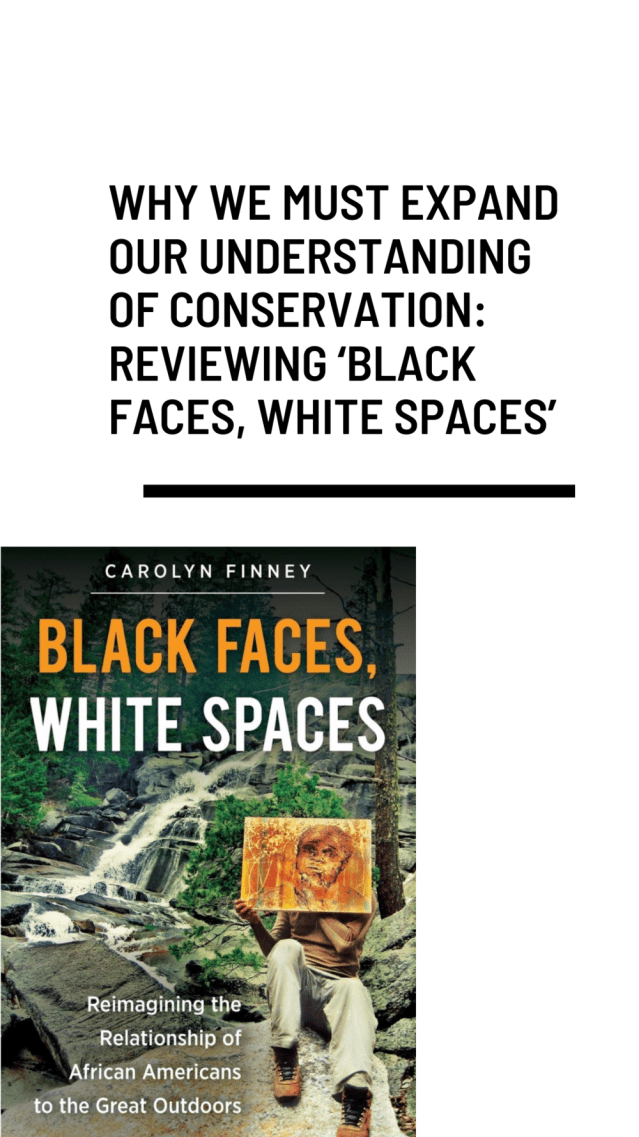
In Carolyn Finney’s ‘Black Faces, White Spaces’, we get a good look at the intertwined history of the environmental movement and African Americans in the United States. Finney guides us through the complicated way race, nationalism, and the ‘Great Outdoors’ manifest into a narrative about conservation that does not necessarily consider people of color’s perspectives and concerns. The book criticizes the historical absence of African Americans from mainstream environmental rhetoric. It explains how this creates invisibility that shapes how Black folks relate to and understand the natural world.
Why Care?
Many argue that environmental movements and policy neglect to acknowledge that not all Americans share all values regarding conservation and the environment. Some see wilderness as a site to preserve for the future generation with clear definitions of acceptable activities such as recreation, scientific research, and leisure. In contrast, others view nature through a lens of interdependence with nature and include activities that hold historical significance (i.e. fishing, hunting & foraging). Because we only predominantly see one prevailing narrative (i.e. hiking & camping) as normative, other activities and views of nature can be at odds (outlawing certain practices at protected lands). Tensions between conflicting views of nature coupled with the prevailing environmental narrative that often marginalizes people of color sows division and creates barriers for further collaborative action. Expanding our view of the environment will only be beneficial. Including diverse perspectives will ensure that the range of concerns reflects the state of the environmental movement.
Although challenging, we must acknowledge that the link between racism, nationalism, and conservation is still present in the way we frame preservation and the outdoors. In their quest to attract a more diverse pool of visitors, National Parks have started showcasing more stories that have been obscured from the mainstream narrative. But tension and conflicts about showcasing these stories illuminate the need to understand the legacies of exclusion in creating environmental movements and policy. Throughout the history of the U.S., we’ve seen that uninhabited wildlands were epitomized as the best America had to offer. This idealization would lead to the relationship between protected lands and what it meant to be American. These sites became where history is told and representative of the collective nation.
The erasure of people of color at these protected parks and landscapes speaks volumes of how we perceive our communities of color as not part of America and do not add to what it means to be American. The perception also goes hand in hand with the lasting influence of eugenics within the conservation movement. Eugenics was premised on the purification of the human gene pool and is predicated on exclusion. The same exclusion we see happened during crucial moments in history, such as during nation-building when the government barred people of color from land ownership and development. The same exclusion occurred when it came to who dictated environmental policy and who would benefit from conservation.
Importance of Expanding Our Understanding of Conservation
A core tenant of Finney’s book argues that representation can help define and expand notions of identity and how people relate to the world around them. In the past and present, the representation of African Americans has often focused on warping their humanity.
“Representation of ‘primitive’ Africans were used to perpetuate and sustain the ideas and values of the West that supported economic growth while at the same time reflecting the feelings and thoughts that justified actions of moral superiority and shaped the social imagination.” (71)
Finney adds that the lack of visual and textual representation in popular media, the National Parks, and environmental education maintains African Americans’ invisibility in environmental management conversations. Finding various narratives in environmental institutions’s major outlets provides representation that shapes and supports understanding of people’s past and where they’ve come from. By acknowledging and making history more transparent, evoking the past becomes a powerful tool for involving the community in environmental preservation and participation. Not only does it provide a way for increased involvement, but it also offers an avenue for healing.
For the most part, when we think about why people of color are not represented in protected lands, we point to a disinterest in nature or cite economic reasons like accessibility. While those reasons are involved and part of the big picture, it’s essential to understand that none of these things happen in a void. A history of violent exclusion and dehumanization has tied the outdoors to a place of danger and possible death.
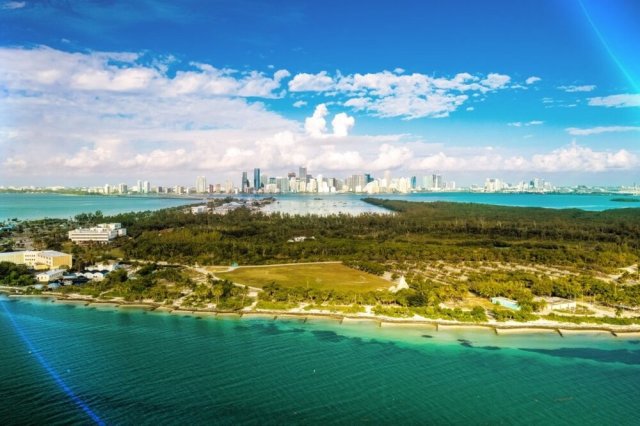
Virginia Key Beach – A site of African American history in the United States. Established in the 1940s due to the recruitment of African Americans by the Navy, it was the only beach in Miami that Black folks could go. Source: Virginia Key Beach Park
Takeaways
I highly recommend this book for those looking to understand the intersections of race, history, and conservation in the United States in a way that is easy to understand and engaging to read. Finney’s book covers much more than just the aspect of representation that I’ve highlighted. It includes interviews with Black folk on their perception of the environment, research into historical African American sites such as Virginia Key Beach, and so much more.
I truly enjoyed Black Faces, White Spaces’. Finney intertwines history, art, popular culture, and media to illustrate how our perceptions are formed by the complicated relationship between people of color and nature. This relationship is emphasized because it continues to reinforce the environmental policies and institutions that are in place. Historical context adds dimension and explains the evolution of that relationship. Each of the chapters adds another layer of complexity to the argument Finney brings forth. From the way that we’ve come to understand and accept a narrow view of the environment to how race and nationalism implicitly tie meaning to land and understanding how collective memory and representation build the narrative of who and how we relate to the natural world.
meet the author
Josefina Artigas
Josefina is a content writer at ecomadic. They hold a BS in Biochemistry and a minor in sociology. Their interests include cooking, anime, and coding. They are passionate about the intersection of sustainability and social justice.
 ecomadic