
.parent {
display: inline; position: relative; line-height: 30px; float: left; color: #82be41;
}
.parent a{
margin: 10px;color: #82be41;text-decoration: none;
}
.parent:hover > ul {
display:block;position:absolute;
}
.child {
display: none;
}
.child li {
line-height: 30px;width:115%;text-align:left;
}
.child li a{
color: #82be41;
}
ul{
list-style: none;margin: 0;padding: 0px; min-width:10em;text-align: center;float: right; font-weight: 550;
}
ul ul ul{
left: 100%;top: 0;margin-left:1px;
}
li:hover {
background-color: white;
}
.parent li:hover {
background-color: white;
}
.expand{
font-size:10px;float:right;margin-right:5px;
}
.parent a p{
display: inline; margin: 10px;color: #6e706b;text-decoration: none;
}
Finding Healing & Resiliency in Upcycling Art: An Interview with Artist Emily Jalinsky
Written by Jennifer MacBain-Stephens | April 24, 2021
Source: Emily Jalinsky
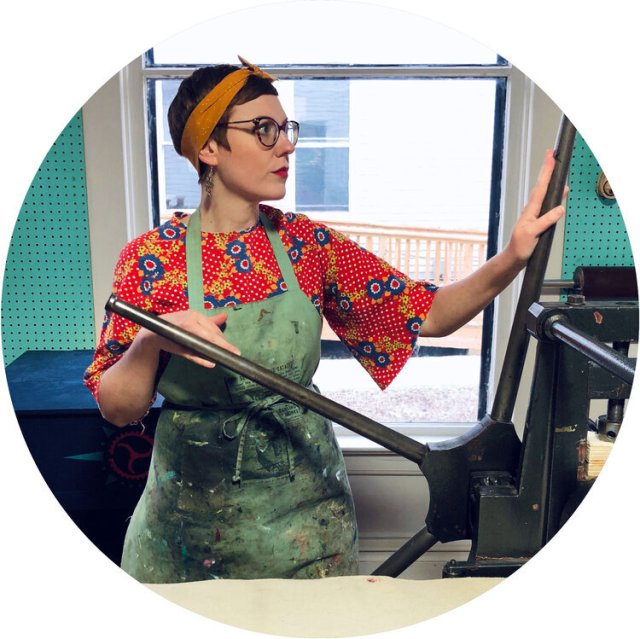
Artist Emily Jalinsky is passionate about accessible art education and collaboration in her community of Iowa City, Iowa and beyond. She is an interdisciplinary artist primarily working in printmaking, pen and ink, watercolor, and embroidery.
Through her works on paper, assemblage, and installation she investigates changing states in the body and mind prompted by her experience with sleep/seizure-like episodes and psychological disorders. Emily has exhibited in numerous exhibitions, including solo exhibitions at CSPS Hall, Cedar Rapids, IA, and the Stanley Museum of Art, Iowa City, IA. Permanent Collections include the University of Iowa Hospital and Clinics and UI Mood Disorder Clinic specialized treatment center for depression. She was selected for the Iowa Arts Council Strategic Planning Partners Series, 2020-2021, and the Iowa Women’s Art Exhibit at the State Capital, Des Moines, IA, 2017. She received a BFA in printmaking from the University of Kansas in 2012 and now lives and works in Iowa City, IA.
Q: Emily, your work is intricate, detailed, almost fairy tale-like. Who are you as an artist/ what inspires you?
I strive to live a creative, slow-paced life with love, mindfulness, and compassion. I grew up with neurological and sleep disorders that helped me slow down (i.e. take lots of long walks) and bring intention and care into my life. Sometimes this has felt like an unwelcome guest, but ultimately, it shaped me into a person that not only needs but craves care and attention for myself and others.
I’m an artist, mother to a curious, energetic toddler, and married to an evolutionary biologist. We spend a lot of our time outdoors on the trails around Iowa City! Hickory Hill is close to our house and our main stomping grounds, but we venture to the fossil gorge and the Solon countryside often.
In terms of my mediums, I’m an interdisciplinary artist primarily working in printmaking, pen and ink, watercolor, and embroidery. Often, works on paper are layered together with found materials to create larger compositions, assemblages, and installation art.
I’m inspired by changing states in the body and mind and avenues that are taken to stay grounded, inspired, or protected: how our internal and external worlds depend on each other, in an elusive spiritual sense and a play between creativity and science. I’m intrigued by the resiliency and solace found in nature, the history and mystery in found materials such as old book covers, and the ritual and ceremony of everyday experiences like making tea and setting intentions.
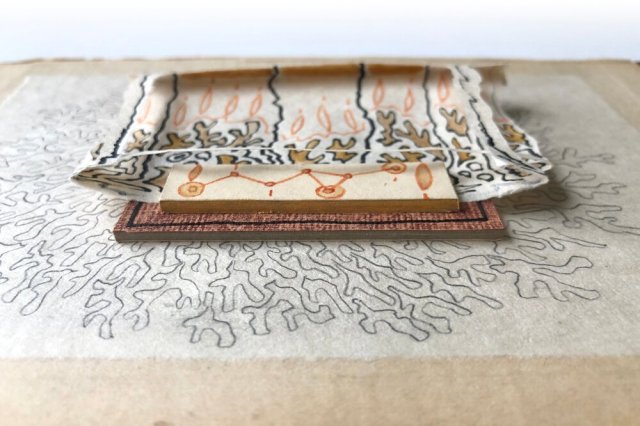
Source: Emily Jalinsky | Art Offering: Fits in Two Hands Held to the Chest #1
Graphite, pen and ink, watercolor, folded and mounted paper with found book cover assemblage.
Inside look at materials from Jalinsky: This started as the middle folded piece during a process-based meditation practice. The smaller pieces of a found book cover in the middle of this piece were part of a cover that has been cut into strips and used in two other pieces I’ve made recently. Most of my stash of vintage books are from second-hand shops in Lawrence, KS and Haunted Bookshop in Iowa City.
Q: What do you do aside from making beautiful art?
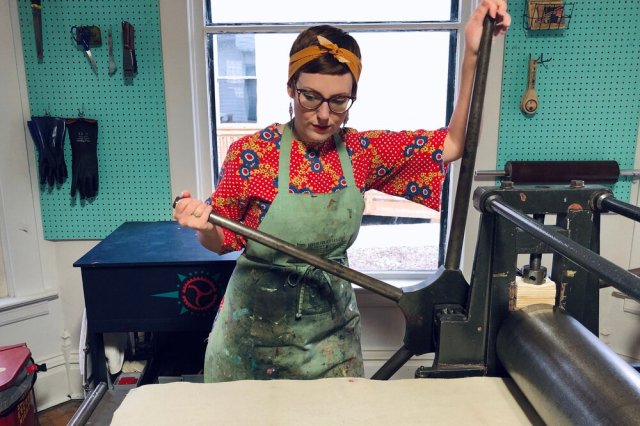
Along with my art practice, I teach printmaking classes and mindfulness, process-based sessions. I also do science illustration work with ink and watercolor, such as graphical abstracts for publications or artwork for conferences and journals.
Q: Describe one of your processes when you reuse or recycle materials.
I’m a process-based artist which means I let each layer inform the next. I hold my themes and/or purpose for a piece loosely while letting it unfold moment by moment. I often start with a print: either from a traditional method made in the print studio or from what I call a tea print. This is a stain left behind from a steeped tea bag with stenciling or stippling on the paper. I work into it with drawing, watercolor, cut paper, or embroidery, finding the flow of the marks.
The paper gets mounted, folded, or wrapped with natural nori paste and married with other pieces from my studio or found materials such as vintage book board or natural materials picked up on my daily walks.
I then revisit materials I’ve already used in previous stages or add something new like gold leaf or string. It’s then placed in my studio, ready for documentation in front of my studio window and eventually a frame, gallery, or packaged for shipping (hopefully going to a new forever home).
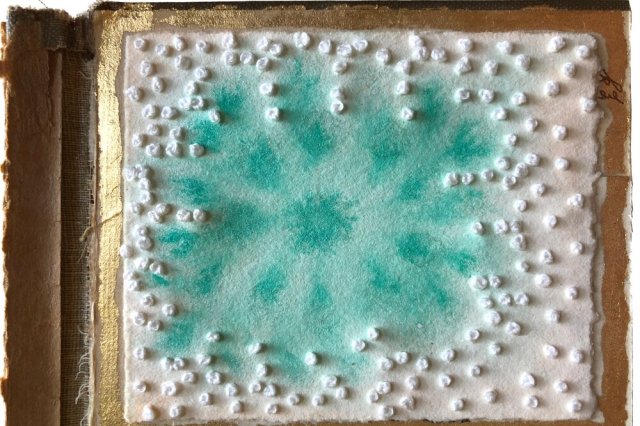
Source: Emily Jalinsky | Transcending in Form: Finding Resilience (detail)
Watercolor, embroidery on paper, gold leaf on found book cover assemblage.
Inside look at materials from Jalinsky: This piece was part of a series of small works I carried with me while I traveled. I had a stack of left-over Rives BFK printmaking paper scraps from previous print runs, along with a bag of embroidery floss, micron pens, and watercolors. When I got back home I mounted them on book covers cut to fit their small, delicate size. However, they were framed larger with layers of handmade papers and white mat-board edged with gold leaf.
Q: Why are you drawn to repurposing items and art materials?
I’m a process-based artist and inspired by mindfulness and attention to our bodies and surroundings. So bringing intention into materials makes sense to me. When I use something from one of my nature walks it holds my own history and the history of that trail or path.
When I use a piece from an old book I’m able to respond to the previous marks, stains, or textures found on it. I like knowing it has experienced a history unknown and yet special to me and to the piece I’m making. It, in and of itself, has been resilient.
I also keep most scraps from my artwork and sewing practice to be embedded into future pieces.
Notes and intentions are also hidden within pieces. So there is a recycling process literally embedded into my work. I feel like all of this enhances the pieces and gives them another level of intentionality.
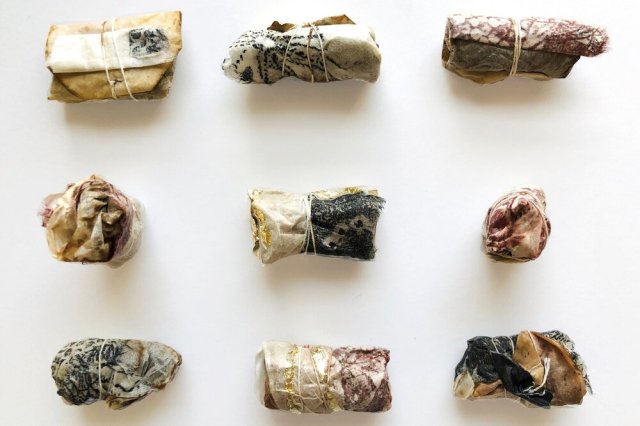
Source: Emily Jalinsky |Art Offerings: Fits on an Alter #1-#9
Teabag, collagraph print, gold leaf bundles.
Inside look at materials from Jalinsky: Teabags are from my daily use- I used the same ones that had dried that week. The prints were proofs from an online print course I offered. I treated them to give a translucency and pasted with the teabags intuitively while applying nori paste with my fingers letting the experience be very tactile for me. I wound the bundles with the teabag string so there wasn’t any added adhesive or bundling. Gold leaf was added at the end.
Q: How do you go about choosing found materials in your art?
My studio is filled with past scraps, smaller unfinished pieces, books, nature gatherings, etc. While I work I try out different materials as I go. Or I’m fervently struck with the need to use one of the materials I have on hand. I try to have everything organized but not to the point where I can’t see them and feel their presence. So they are not locked away in a closet. They are sprinkled around my studio on shelves, open containers, etc., ready and receptive.
Q: How did the process of reusing pieces come about for you?
When I was in college at the University of Kansas from 2006-2012 I had the most fabulous teacher and mentor: Carol Ann Carter. She is still a phenomenal practicing artist. She taught me the method of process-driven art and I have never looked back. I found a way to bring my love of printmaking to this way of working as well.
Through my struggles with health, I also learned mindfulness meditation and biofeedback. These practices gave a foundation to my daily life and studio time. Using found materials, reusing scraps and prints, and implementing eco-friendly shop cleanup, are intuitive continuations of these daily/studio approaches.
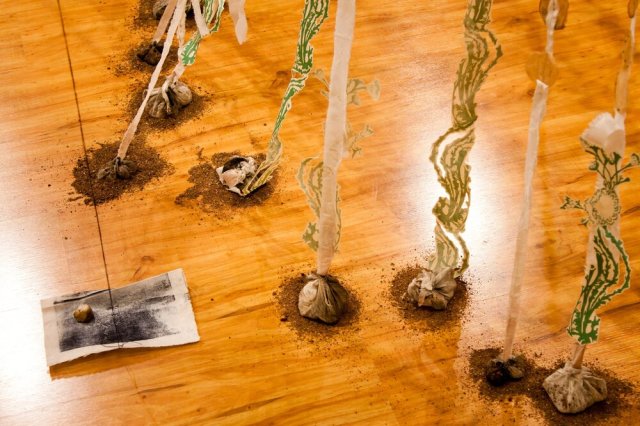
Source: Emily Jalinsky | Inner Calm
Installation with silkscreen on cut paper, embroidery, teabags, and stamps on torn fabric, string and xerox lithography on paper, tarlatan, tea leaves, and rock bundles.
Inside look at materials from Jalinsky: Both the silkscreen and xerox lithography prints were used for other editions and one-of-a-kind pieces. The original books scanned for these prints have been used in my original works for the past five years and continue to be a recurring material in my current work. Teabags and loose tea leaves were from my daily tea rituals. Stamps were hand-carved from erasers I used in college. The fabric was from a small stash of quilting fabric from my late grandmother. The tarlatan bundles were all from previous intaglio print runs and filled with borrowed rocks from my high-school assistant’s personal rock collection.
Q: What does the future have in store for you?
I will continue working in this way because it’s part of the structure of who I am now. I also continue to be mindful of my choices as I learn about sustainability and our impact on our planet.
I continue to learn through my illustration work with Maurine Neiman’s lab and the science field that surrounds my husband’s work. I’m not perfect in this regard but I’m thankful to learn as I go and bring mindful awareness to this knowledge.
Q: What is a new inspiration that you are excited about?
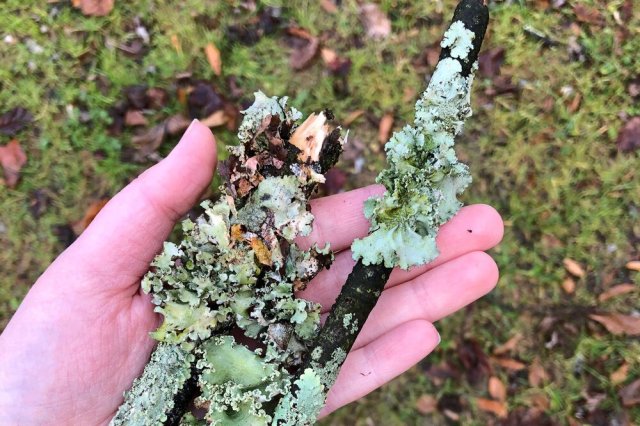
I look forward to learning the art of natural dyes and watercolor from lichen!
I recently found an artist community doing just this and hope to learn from them in the coming year. I’ve dabbled with natural dyes before but I’ve never gone through the process in its entirety, let alone with a plant that speaks to me so deeply. Adding foraged, homemade pigments feels like the natural next step in my work’s progression.
Source: Emily Jalinsky
Q: What draws you to lichen?
Lichen started grabbing my attention in my early twenties as I was in art school and developing my own visual language. Due to my sleep disorders, I wasn’t able to drive and often had to lay down to rest or have an episode. Sometimes I would lay there for over half an hour conscious of my surroundings but not able to move yet. This was nothing new, I had been experiencing this since adolescence, but when I was in art school I learned to use these times as part of my research: to use my power of observation during these moments. Then I learned mindfulness and started using these moments of physical impairment as a time to meditate.
When I observed lichen and learned of its slow-growing nature (growing for hundreds of years) and resilience it quickly became my totem plant/guide. I learned it not only survived through drought and rough conditions but animals, including humans, can eat it to survive. It’s also a symbiotic organism made up of fungi and algae.
I suppose I have always thought of myself as a lichen since learning these things. I am slow to move, slow in my process, always in need of community and others for help, but hopeful for continual growth and giving back with artwork for mental/spiritual sustenance.
At one point I had wanted to make all of my own paper as well but I am blessed with many friends from the Center for the Book at the University of Iowa who make paper and share their bounty with me.
Q: What Art businesses do you support?
I do my best to buy art supplies from companies I admire such as our local Blick store and McClain’s Printmaking Supplies. I’m moving more and more in this direction and curbing my habit of getting cheaper, more accessible materials from online vendors. This is something I’ve been learning from my friends and peers at Public Space One. They continue to be the best example of a homegrown, ethical, supportive, inclusive arts ecosystem. A large part of my art journey and support system in Iowa City is due to them!
Local artists like Emily help build bridges between communities and also inspire all of us! By making her art visible, not only do artists like Emily start conversations about vulnerabilities and ways of sustainable expression, but she also encourages other creatives to share their work and use their voice.
Source: Emily Jalinsky
Here are 5 ways we can support artists:
-
Buy their work online.
-
Promote them on your social media.
-
Donate to your favorite arts organization.
-
Attend in-person event when it is safe or especially if it is outside.
-
Order a custom-made piece.
To contact Emily Jalinsky or to see more of her work go to:
IG: @emilyjalinsky
Etsy Store: Sleepy Press
meet the author
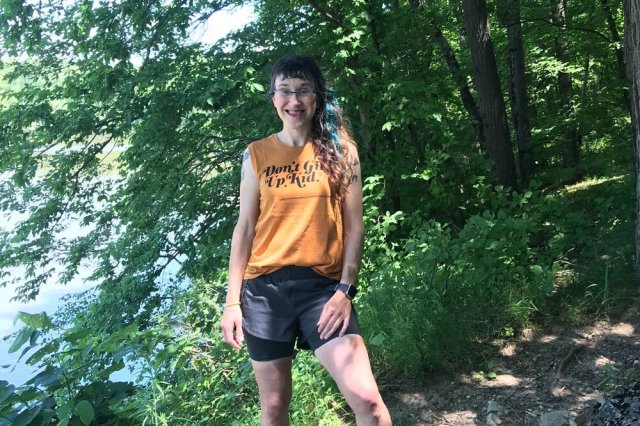
Jennifer MacBain-Stephens
Jennifer MacBain-Stephens went to NYU’s Tisch School of the Arts and now lives in Iowa where she likes to rock climb, hike, and mountain bike. She is the author of four poetry collections and enjoys exploring how to blend creativity with nurturing the earth. She also hosts a free, monthly reading series sponsored by Iowa City Poetry called Today You Are Perfect.
Find her at: http://jennifermacbainstephens.com/.
 ecomadic