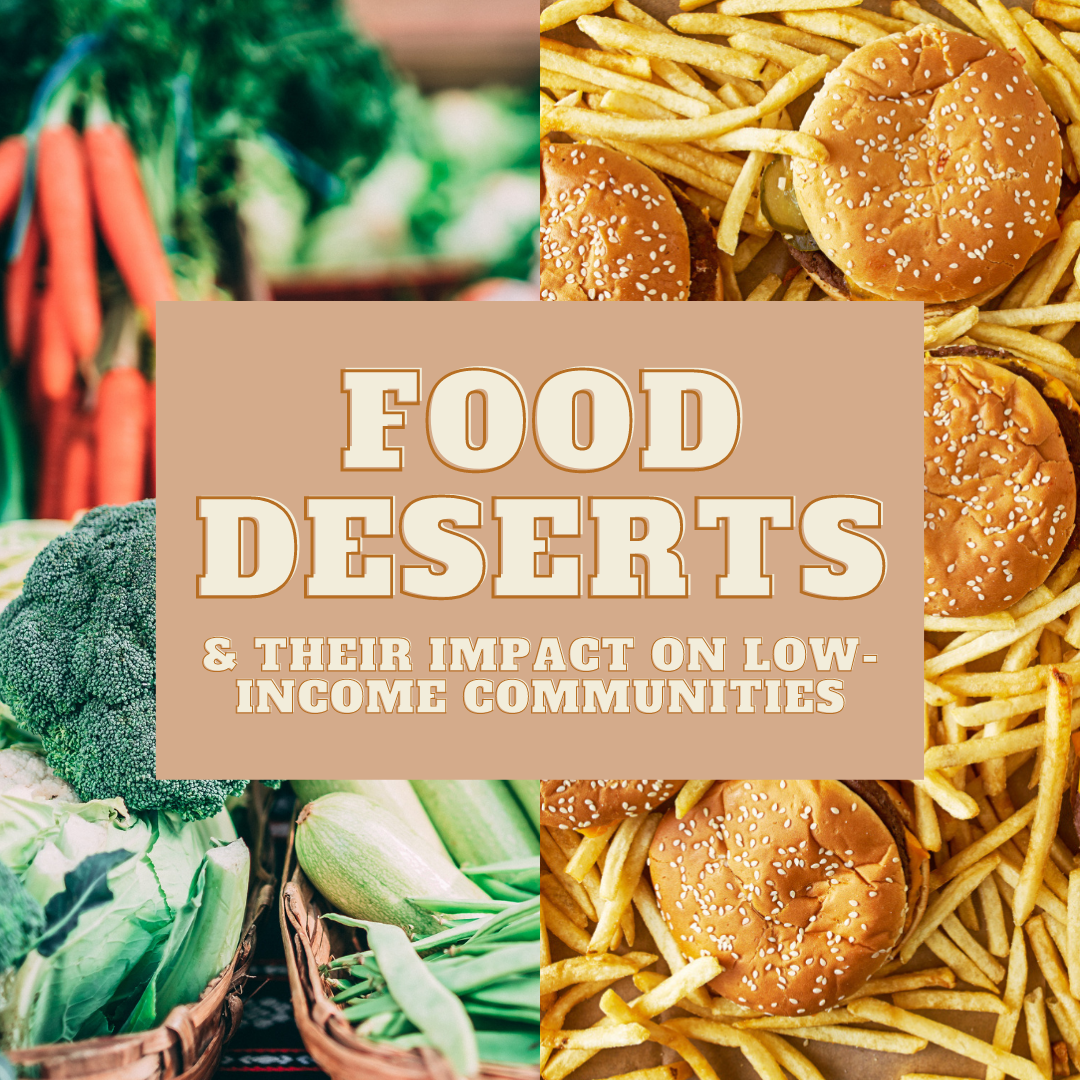
A food desert is an area within a community with limited access to healthy eating and new sustainable resources. The term ‘food desert’ itself is relatively new, but the implication has always been around. These can often be found in impoverished neighborhoods in contrast to an area with higher access to fresh markets. People who live in food deserts are more likely to consume highly processed foods with little to no nutrients. For many people, living in food deserts can lead to diet-related chronic diseases.
Where Are Food Deserts Located?
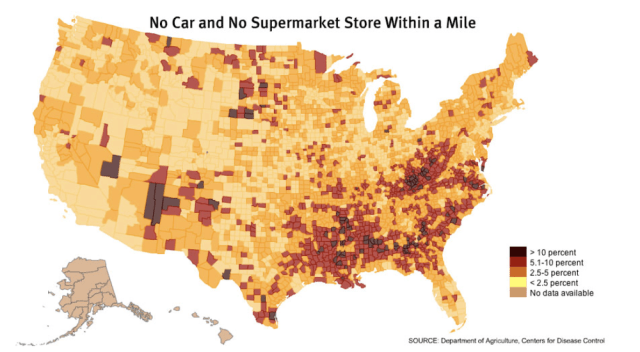
Food deserts are generally located in Black, Brown, and impoverished communities with low accessibility to resources, such as cars. Two families could live in the same neighborhood, but if one has a vehicle and the other has to rely on public transportation, that can make an enormous difference in how people access their grocery stores.
The rural South and Midwest regions of the United States are more likely to become food deserts as opposed to places in the Northeast. Compared to supermarkets and farmers markets, you will often be met with convenience stores and gas stations in a food desert. However, food deserts aren’t just about access to grocery stores. Food deserts are about needing access to healthy, sustainable foods. Many convenience stores in these neighborhoods get their produce second hand; meaning that it could already be well past the sell-by date when the food is being sold.
Who Lives in Food Deserts?
Rural communities with high unemployment rates are more likely to become food deserts. Without routine access to a car, it can be challenging for people to avoid buying their produce from a place of convenience or nearby location. Oftentimes, people do not realize they live in a food desert because they have never been exposed to alternatives. Yet people who live in food deserts are exposed to more health concerns, such as risk of heart disease, diabetes, and high blood pressure. If there are chances that a local supermarket has healthier produce, they are often too expensive for the average person living in that area. With approximately 23.5 million people living in food deserts and nearly half of them being low-income households, food deserts are more common than one might think.
Why Sustainable Food Consumption Should Be Available to Everyone
Diabetes was ranked as the number 9 top cause of death globally by the World Health Organization. It is no secret that frozen dinners are often quicker, easier, and cheaper to prepare for the average person. Further, food that contains preservatives is put into boxes and cans, which tends to last longer in a standard U.S. household, resulting in a higher overall use from large families.
For example, in January of 2019, Greensboro, North Carolina closed one of its most promising grocery stores – the Greensboro Renaissance Community Co-Op. The store had only been open for three years before closing, and was located in a largely Black and low-income neighborhood. It was the first sustainable grocery store in the community since 1998. For cases like so, surveys have found that there are 17 food deserts in Greensboro alone.
As a society, we can’t ignore the implications of our food production and food consumption and its role in the current climate crisis. With deforestation and the changing weather patterns affecting agriculture growth, food deserts have a drastic negative impact the planet.
What Are People Doing to Help Eradicate Food Deserts?
Co-Ops are a great way to shop sustainably and buy from within your community. Compared to larger grocery store chains, co-ops are independently owned by the people residing in the community; they are the best way to find local and fresh food from the surrounding region.
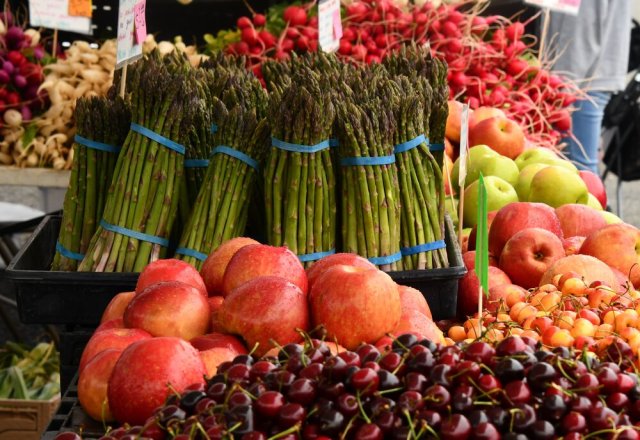
📷 @shelleypauls
Farmers Markets are another excellent way for community members to gather and sell their local goods – which is a great way to promote sustainability too! It can be challenging for local farmers to compete with large corporations, but having a community outlet to sell products allows for local and small farmers to make a living from their goods.
Thankfully, we have seen many initiatives pop up over the years in the fight to eradicate food deserts. In 2017, First Lady Michelle Obama started the “Let’s Move” campaign with the ultimate goal to fight childhood obesity and provide greater access to healthy food. Another example can be found with the Healthy Corner Stores Network, who are on the mission to diversify the quality of food options in bodegas and convenience stores across the United States – including fresh fruits and vegetables.
In the world of social media and online presence, we are in a better position than ever to educate people on the importance of sustainability and healthy consumption. Through education and initiatives that aim to provide widespread accessibility, hopefully we will one day be in a place where all people have the option to choose quality.
Raven is currently a college student residing in Charlotte, NC. Her interests include traveling and exploring the world through different lenses. Having a passport from before the age of walking has instilled the value of different cultures as a part of her identity. She is passionate about spreading awareness on political and social issues in the United States and abroad.
The fashion industry has quickly evolved to keep up with the culture of consumerism – we want to buy more and we want to buy it quickly. Unfortunately, haute couture is not accessible to everyone, so fashion retailers of big companies like H&M and Zara have found the perfect recipe to drastically increase their profits: using the latest high end trends to produce ridiculously cheap new collections as fast as possible. It comes without saying that these rhythms of production have an extremely negative impact on the environment, making textile production responsible for 1.2 billion tonnes of greenhouse gases emissions annually, which is more than all international flights and maritime shipping combined.
What is Fast Fashion?
By definition, the term fast fashion implies “inexpensive clothing produced rapidly by mass-market retailers in response to the latest trends”. It sounds awesome right? Well, think again.
The strategy behind fast fashion is emulating the newest trends that high end designers came up with, then reproducing the designs with cheaper materials and lower production costs; all of this while producing as fast as possible so that consumers are constantly drawn to buy their newest pieces. It makes sense, as consumers “we want the feeling of luxury without paying full price. We want to look expensive-ish”, Hasan Minhaj stated in an episode of the Patriot Act titled ‘The Ugly Truth of Fast Fashion’.
While buying a shirt for $2.99 or a dress for $5.99 sounds convenient, we all know that that’s not the only piece we’re going to buy for the rest of the year. Veteran fashion journalist Dana Thomas has estimated that the average American in the 80s would buy about 12 items of clothing a year. Today that number went up to 68 items a year.
Saying it a little louder now for the people in the back: 68 pieces a year.
We all know that we don’t need that many clothes, but brands such as FashionNova, H&M, Zara, Topshop, and others, aim to make us want them. And this constant desire for new clothes comes also from the fact that those clothes are produced with ridiculously cheap materials, which means that they’ll get in bad shape pretty quickly. In fact, the same average American who buys 68 new pieces every year, also dumps 80 lbs of clothing in the same period of time, creating a huge amount of unnecessary waste. And yet, as soon as a new Zara collection is released, we’re trained to think that we need it.
Still from “The True Cost” documentary.
The Impact on the Environment
Overall, the fashion industry as a whole is more harmful to the environment than the aeronautical and shipping industries combined. In other words, the clothes in our suitcase are contributing more to climate change than the plane we’re traveling with.
The average production period for a high end fashion brand’s new collection is around 2 years. The secret of fast fashion brands is to cut the production time down to 4 months, and release new pieces every week so that the regular 4 seasons of fashion becomes as many as 52 seasons. How do they keep up with these rhythms? Easy: cheap labor (*cough* exploiting their workers *cough*) and an additional complete disregard for the environment.
According to the calculations of the Intergovernmental Panel on Climate Change (IPCC), the fashion industry produces 10% of global carbon dioxide emissions every year, and uses around 1.5 trillion liters of water annually. Additionally, the production of synthetic materials such as spandex, nylon and polyester requires 342 million barrels of oil per year.
Furthermore, 150 million trees are logged every year and turned into cellulosic fabric (like rayon or viscose), and just 30% of the harvested wood ends up in the clothes that we wear, while as much as 70% is dumped or incinerated. To put that into perspective, if placed end to end those trees would circle the earth seven times. And if that wasn’t bad enough, there’s more: of all the fabric used for clothing, 87% ends up in a landfill or incinerated, and yes, that includes the clothes we donate.
At this point it’s hard to look at the composition of the clothes in our wardrobe and not feel personally responsible for destroying our planet.
The Alternative to Fast Fashion
Although it might seem like fast fashion is the only way to purchase clothes that are not as expensive as our rent, it’s not. Here are some alternative ideas:
1. Clear out your closet and re-discover the pieces you already have.
You’ll be surprised how many pieces of clothing come back in style through the years. We’re used to burying the stuff we don’t like anymore at the bottom of our closets, so we’re not always aware of the options we actually have. Also, don’t be afraid to experiment with your parents’ and grandparents’ wardrobe! There are some real gems in there.
2. Thrifting, thrifting, thrifting.
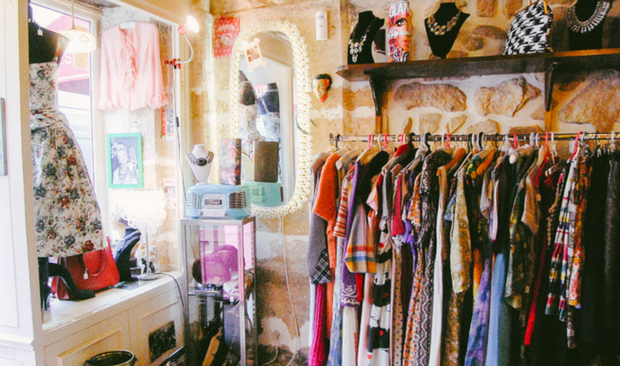
Turns out Macklemore had it all figured out. Thrifting is the most sustainable way of shopping: nothing produces less waste than secondhand clothing. Nowadays there are so many options to choose from when it comes to thrifting, and the most recent trend in fashion is actually vintage clothing. Nothing compares to finding a unique piece of clothing that nobody else has, and it is so cheap!
Thrift store music video – Macklemore & Ryan Lewis
3. Dive deep into a sustainable brands research.
There are always more truly sustainable brands around the world, which can be recognized by the transparency of their production methods and materials they use. It only takes a little bit of research, but we should always be informed about the products we spend our money on. On that note, we’ve done some research or you, and we created a list of many amazing responsible businesses. You’re welcome! 😉
4. Shop local and small.
Eco-friendly brands can be expensive sometimes, and not easy to find everywhere. So if none of these options are available to you, you can always support small and local brands instead of big corporations like H&M and Zara.
Source: Vintage Industrial Style
Beware of Greenwashing
Greenwashing is the misleading of green claims to reap the social and economic benefits of being perceived as “sustainable”. In other words, it’s a marketing strategy aimed to trick consumers into thinking that your company is environmentally conscious, while making extremely limited efforts to implement practices that are truly sustainable.
The fact that many brands are publicly commiting to make their businesses more green is a relief, but we can’t simply rely on their words. There is no legal definition for terms such as “green”, “sustainable”, “consciously-made”, so we need to look at the facts and make educated choices about the businesses we support.
Transparency is the key factor to recognize whether a product is actually green or not: what is the percentage of sustainable materials used in that product? How are they sustainable? Where are they sourced from? How clean is the production process? And, most importantly, are sustainable products just a small fraction of the company’s inventory?
What Can We Do During the Pandemic?
Staying home during the lockdown has given us too much free time, most of which we spend on our phones or laptops. Being bored with a phone in our hands is the perfect recipe for impulsive shopping, and, unfortunately for our wallets, shopping online has never been easier.
While purchasing clothes from our home instead of going to a physical store makes us amazingly responsible citizens, all of those packages that arrive at our doorstep have an incredibly negative impact on the environment.
The main problem is the CO2 emissions of delivery vehicles. In fact, according to environmental scientist Sadegh Shahmohammadi, shopping from online retailers causes the highest level of greenhouse gas emissions compared to in-person shopping and local-store deliveries; which is respectively 0.18 kilograms, 0.1 kilograms, and 0.07 kilograms of CO2 per item.
So if we really need to shop right now, the safest and most sustainable option is online thrifting, and if you’re having trouble finding some in your area, the most recent trend of online secondhand shopping (since ebay) is thrifting on Instagram. I know… what a world.
By searching for thrift stores on your Instagram you’ll find awesome local boutiques that will take your order and deliver it to your home. The best part is that some of them even personally deliver it through public transportation, drastically reducing their CO2 footprint.
So get to searching, and discover these amazing hidden treasures right next to you!
Giuliana was born and raised in Sicily (an Italian island in the middle of the Mediterranean Sea), since then she’s been moving around the world to meet new cultures and discover new places. She has a degree in Political, Social and International Sciences. During her studies she became passionate about environmental protection, gender equality, and cultural identity. She loves traveling, petting dogs on the street, and swimming underwater.
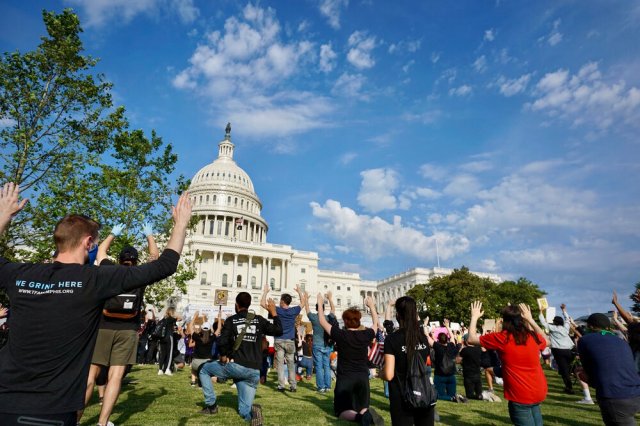
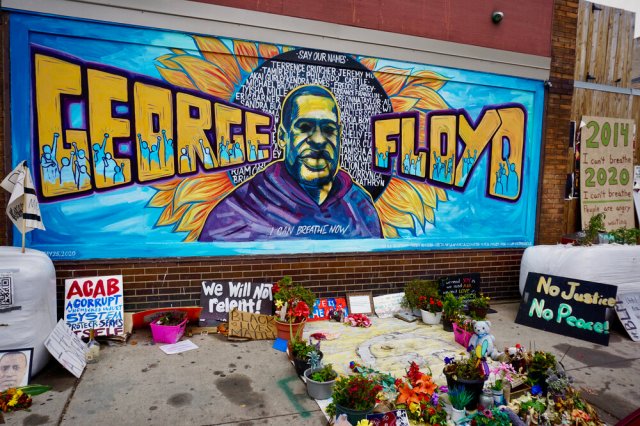
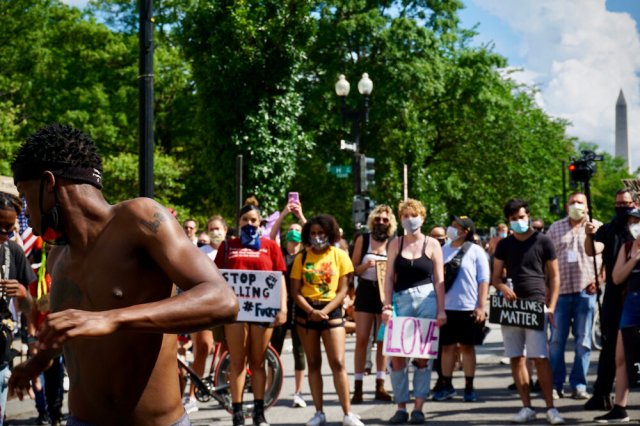
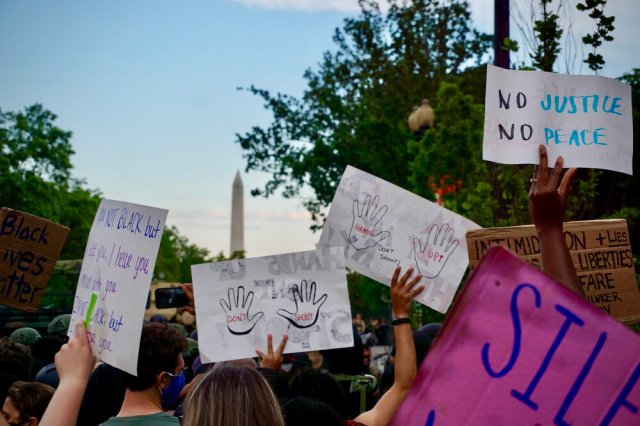
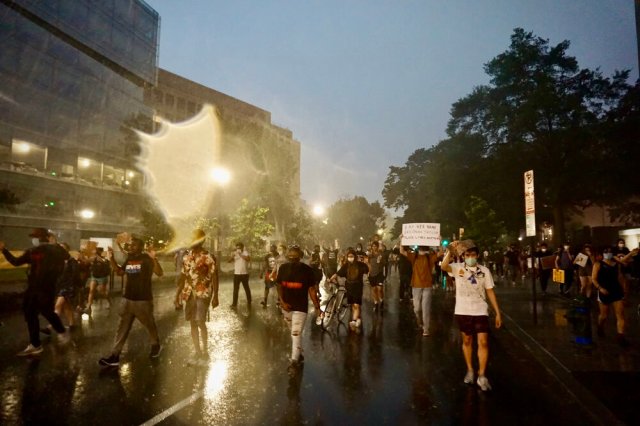
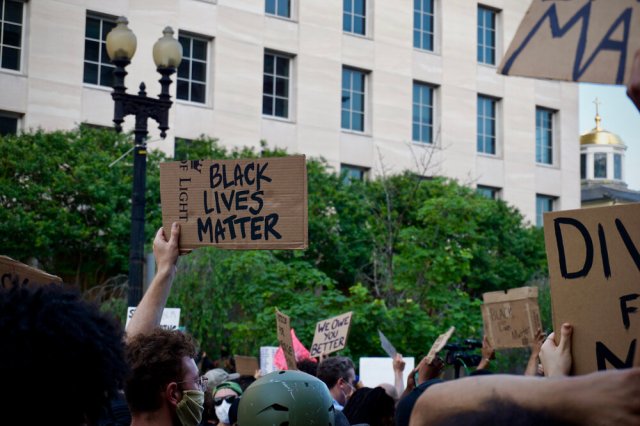
After the tragic death of George Floyd on May 25, 2020, pressing urgency on racial injustice was reignited around the world. Millions of people took to the streets to express their emotions – making the Black Lives Matter movement the largest in United States history and spanning into every continent, aside from Antartica. The aim of this photo essay is to showcase the fight for justice across the nation; visualizing powerful artistic and demonstrative expression.
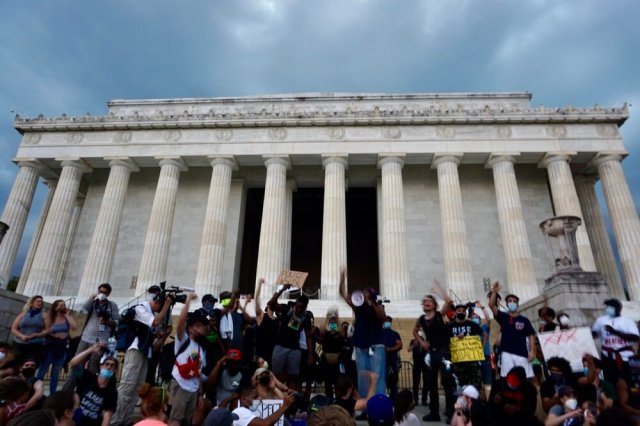
Emotional speeches given by Black Lives Matter demonstrators on the steps of the Lincoln Memorial. 📷 Jaclyn Yost
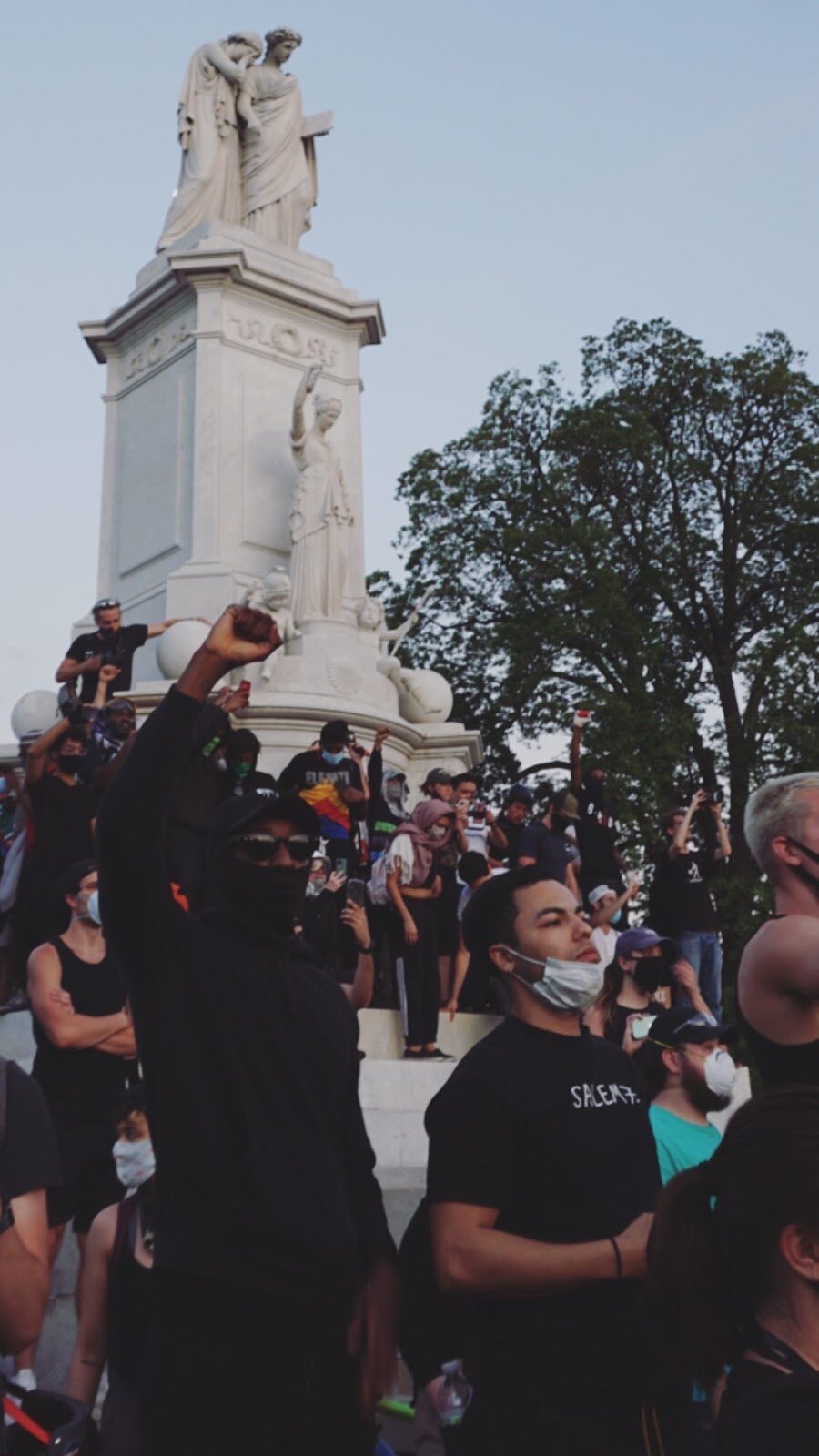
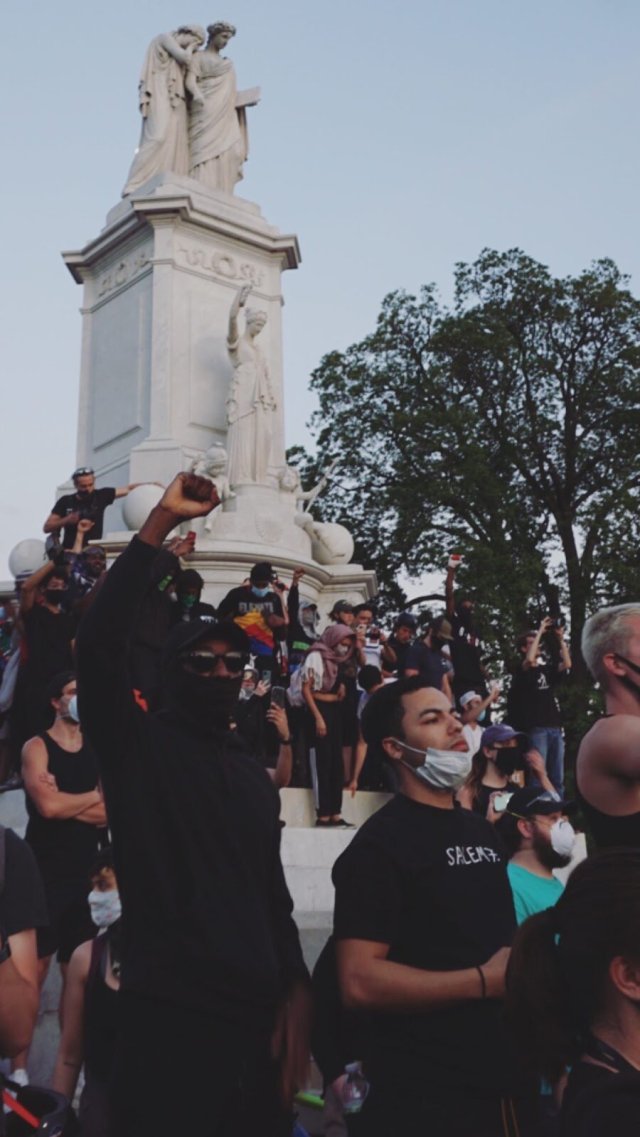
Peaceful protesters gather on the Capitol lawn in Washington DC. 📷 Jaclyn Yost
George Floyd memorial in Minneapolis, Minnesota. 📷 Jaclyn Yost
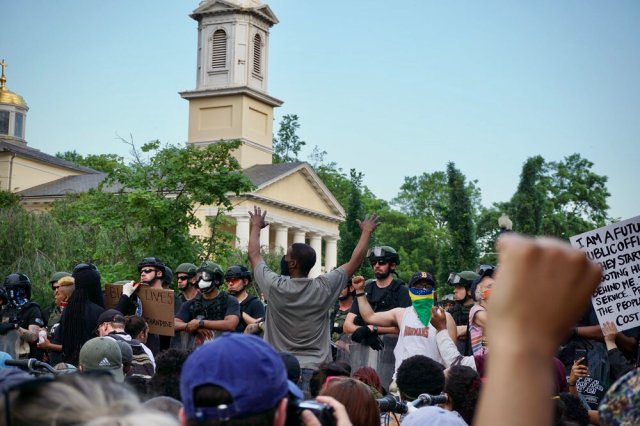
After former US president Donald Trump tear gassed peaceful protesters for a photo-op in front of the St. John’s Episcopal Church, demonstrators conveyed their distrust in police protection of society. 📷 Jaclyn Yost
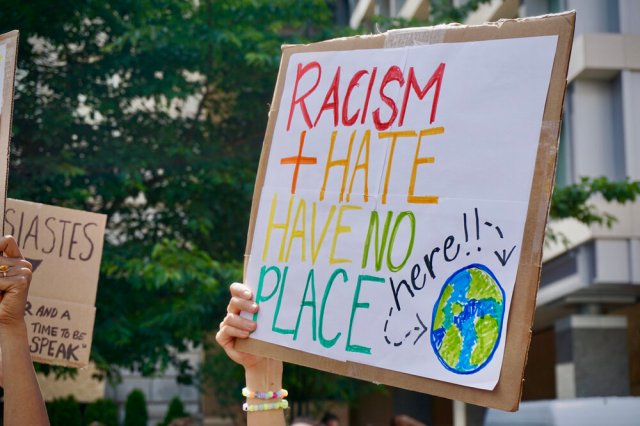
Protest signs at a march in Washington DC. 📷 Jaclyn Yost
Street performers at Black Lives Matter plaza in Washington DC. 📷 Jaclyn Yost
A crowd gathers in front of the White House. 📷 Jaclyn Yost
Black Lives Matter protesters marching through a downpour in Washington DC. 📷 Jaclyn Yost
A child dancer joins street performers at Black Lives Matter plaza in Washington DC. 📷 Jaclyn Yost
Black Lives Matter signs at a march in Washington DC. 📷 Jaclyn Yost
Want to learn more?
Check out the Black Lives Matter organization here.
meet the author
Jaclyn Yost
Jaclyn is the founder of ecomadic and editor of The Sustainable Seed. She is conscious creative passionate about shedding light on environmental and social sustainability issues through travel.
As ecomadic continues to celebrate Black History Month, we also want to amplify as many voices in the Black community which contribute in promoting an eco-friendly lifestyle. In the age where information is easily shared through social media, why not uplift those who specialize in creating informative, environmental content on Instagram, TikTok, YouTube, and other social media platforms? To guide you in doing so, here is a list of nine Black environmental influencers to follow and enjoy throughout, and even after the end of Black History Month.
Tabitha Brown
Source: The Beet
Labeled as “America’s Mom” by Huffington Post, Tabitha Brown is the personality providing comforting and chlorophyll content to social media. A working actress, she became popular on social media from a TikTok video of her reviewing a vegan BLT sandwich from Whole Foods. Since then, she has gone on to post various videos of her cooking vegan dishes, and motivational messages about the vegan lifestyle, and living life to the fullest. Her reason – well, as she says, “that’s my business” – but also, veganism gave her a new perspective on life during those melancholic moments where she wasn’t mentally or physically healthy; which is why she hopes that her story and the positive energy she displays on her platform will reach anyone of any age that who is seeking for a lifestyle improvement. Be sure to follow for inspiration and delicious recipes!
The Missouri-born blogger Leah Thomas uses her voice to speak on intersectional environmentalism! Through Instagram posts and various articles she’s written on The Good Trade, Elle, and Vogue, she calls out the injustices marginalized communities face, which goes hand in hand with the environment said communities reside in (e.g. Flint water crisis). An environmentalist, she doesn’t want the planet to only be put first, but for people as well, specifically those affiliated with oppressed groups that often get left out in conversations on environmental activism. As she amplifies the voices of various social justice activists and environmentalists from the non-mainstream groups, we uplift hers, and join the fight for equality and sustainability on Earth!
After discovering chicken nuggets and regular milk came from animals at the age of 6, the now 14-year-old activist is on a mission to protect animals, humans, and Mother Earth. Through Ted Talks, podcasts, documentaries, and posts on Twitter and Instagram, Genesis hopes to bring awareness on a lifestyle that is cruelty free to all organisms, while aiding her generation in attaining a sustainable and eco-friendly lifestyle. Seeing someone strive for a healthier future at her age is such an inspiration for us all – and she still has more achievements to come. Support this young lady and her platform as she continues to blossom into the best activist and influencer that she can be!
After an eye opening documentary on veganism, Joshua Black was able to reverse his health risks, and begin a new chapter of his life. Now as the Urban Black Vegan, Black hopes to teach people the process and benefits of a vegan lifestyle, especially those in the Black community who are apt to various health conditions such as diabetes and high blood pressure. Through his Instagram, Twitter, and YouTube, Black shares information on various foods, how to portion, and how not all vegan foods are healthy foods. He also tackles various social issues within the vegan community, such as the lack of inclusivity of marginalized groups. As he continues to break down barriers to spread veganism and sustainability to a larger audience, we shall also follow him and his journey, for it may improve our journey towards a sustainable lifestyle!
A sustainable living enthusiast, Addie Fisher blogs and shares with the world her environmentally-conscious lifestyle, to boost others in becoming eco-friendly. On her blog, Old World New, she shares resources and tips on composting, thrifting and creating green cleaning products using recyclable household items. Although she is aware that there are people with insufficient funds or access to organic and ecological products (which she advocates to solve these issues), she tries her best to showcase a sustainable lifestyle that is inclusive to all walks of life. Follow her blog and social media pages to see how “everything can be done sustainably”!
Shop ‘til you drop sustainably with social sustainability activist, and ethical street style influencer, Dominique Drakeford! Founder of Melanin & Sustainable Style (abbreviated as #MelaninASS) and co-founder of Sustainable Brooklyn, Drakeford uplifts creators of color in the sustainable fashion and beauty fields, and educates those on environmental sustainability through the African diasporan lens. With Black voices often silenced during environmentalist conversations, Drakeford uses her platforms as safe spaces where marginalized groups can be heard. From decolonizing environmentalism, to sharing various black-owned fashion, beauty, and wellness products, be sure to subscribe to her many platforms to help her and many black, sustainable creatives become more visible!
From across the pond, Aja types and posts about the intersectionality of sustainability, social issues, and the fashion. When she’s not writing for The Guardian, CNN, and Eco-Age, Barber posts microblogs on her Instagram page discussing consumerism and sustainability, diversifying social media feeds, and the negative impact fast fashion and inequality can have on the environment. Through her research, and her experiences in living in the US, and currently the UK, she hopes her informative content will aid her audience in choosing fashion that is not only sustainable, but inclusive.
“Nature never tasted so good” Andre’s instagram states as he invites you into a world of delicious vegan meals! For foodies, PlantbaseDre is a haven of herbivore-esque meals created by Andre himself, or that he has tasted from various vegan businesses in the United Kingdom. He also has a YouTube channel showcasing his recipes from the brand By Nature Food, which he created with his mate, Mikey. While plant-based food options, like sweet potato chickpea curry, or vegan chicken fried rice, are prominent on his page, he is also upfront about spreading positivity and making sure everyone takes care of their physical and mental health, especially in the wake of the pandemic. Be sure to follow him, and get better connected with enjoyable food, other vegans, and nature!
Scotland’s Mikaela Loach supports sustainability with inclusivity! Knowing that there are plenty of people who cannot see themselves in the mainstream world of environmentalism, Loach makes it a mission to be the voice for those groups, in hopes to provide a space for the underrepresented to be uplifted. Through her Eco-Age blog posts and Yikes podcasts surrounding climate change, secondhand shopping, anti-racism, and global ecological crises, Mikaela supplies a plethora of information and resources to aid our planet in becoming a healthier and greener place. Support an Edinburgh environmentalist this month, and many months to follow!
Rj Ross is a writer at ecomadic. With his BA in communications and love for creative writing, he hopes to inspire and inform many generations about sustainable living and responsible traveling.
February is here, the shortest month of the year! The month where Aquarius season ends and Pisces season begins. The month where we celebrate holidays like Valentine’s Day, Carnival, and Superbowl Sunday. But that’s not all we celebrate in the second month of the calendar year (at least in North America). February is also Black History Month, a month celebrating Black culture and Black people who pave the way for many generations to come. What better way to celebrate Black History Month than to shop and dine Black? We at ecomadic have put together a list of eco-accommodations, socially responsible eateries, social enterprise shops, and ethical tours for you and your bucks to bask in throughout February.
A place to stay safe and small, Akwaaba’s bed and breakfast inns are the perfect places to stay when in need of a getaway. In five different locations (Brooklyn, New York; Cape May, New Jersey; Philadelphia, Pennsylvania; The Poconos, Pennsylvania; and Washington, DC), Relax in a hospitable home filled with gorgeous decor, hearty and healthy breakfast options, spacious areas, all which are located in areas walking distance to many wondrous attractions. When you’re not exploring the city culture, you can experience a slice of Black culture from the comfort of your room; read various literary works by African American writers in the DC Inn, or vibe to the sounds of Phildelphian musicians when staying at the Philadelphia Inn! Wherever you stay, Akwaaba will provide many beautiful, unforgettable memories!
If a hotel or inn is out of your budget, this hostel in Houston will give you enough bang for your buck! With prior experiences in staying at a hostel, Wanderstay CEO Deidre Mathis wanted to provide a space for out-of-towners to bond and build relationships, while allowing them to experience the city life of Houston, Texas, without having to worry about pricey lodging costs. Once you awaken from your slumber on the hostel’s high-quality mattress, and grab a cup of its complimentary tea and coffee, check out the local restaurants, lounges, and museums that are just a 10 minute walk or bike ride (bikes are available to rent at Wanderstay). Also, depending on where you go, you may get a discount, compliments to the Houston hostel! Grab your lone stars and come on down to Wanderstay for an inexpensive, H-town adventure!
This online boutique is “making old things new”, as its Instagram tagline reads, with upcycle fashion! Based in Louisiana, Lakeitha Washington (also known as Ms. Kaye) prides in making her customers feel fierce and fabulous in vintage and reworked clothes she crafts and sells, such as reworked Lucia blazers and vintage Mickey crops, and many other sets frequently dropping on Friday (classified as “New Arrivals”). Be sure to have your credit card or other forms of payment (listed on the website) ready for an upcycle experience like no other!
Keeping traditional African practices and techniques alive, Aurora James created Brother Vellies to craft beautiful shoes, handbags, and other cultural decor for your buying pleasure. Though located in Brooklyn, New York, Brother Vellies works with artisans in many countries such as Kenya, South Africa, Morocco, and Haiti, to produce alluring accessories, in a responsible fashion. All accessories use natural and recyclable material (e.g. hand carved wood; floral dyed feathers; products sourced from farmers) and all craftspeople are always in contact with Aurora James and the team to ensure their working conditions are safe and ethical. Shop on their website to invest in a portion of the many cultures sculpted into eco-friendly attire and accessories.
You want to look fine, but your humble abode wants to look finer! That’s when PUR Home comes along with cleaning products to keep your residency relieved of any waste! PUR Home specializes in cleaning products that are not harmful to anything or anyone it comes in contact with. Using biodegradable products like citrus peel oils, glycerin, and aloe vera leaf juice (all ingredients can be found on the website) in their sprays, sanitizers, soaps, and detergents, your kitchen, bedrooms, and bathrooms will be feeling fresh and organic as Mother Nature herself intended. Another amazing aspect of this company is that it’s Leaping Bunny certified – meaning that none of the products were tested on animals. A company that spreads awareness on proper treatment to the environment and the laborers who help manufacture products, it takes a mere spray and swipe to clean your home with PUR Home’s biodegradable products!
After a stressful day, sometimes it’s just nice to relax with a beverage, some smooth jazz, and a few lit candles. 12th Glow fulfills the latter. In the name of self-care, 12th Glow shares with you its assortment of candles and wax melts to ease your mind and let the candlelight make your inner glow shine! Candles such as “Boss Up”, “Bae”, and “Relax, Sis” are all made with vegan products, and are manufactured by wax companies that value the environment and human life. Aside from selling candles, the company also hosts workshops and events (often via Zoom and Instagram Live) to uplift their clients, and guide them to a life of positivity. Be sure to attend one of them to ignite your inner peace and happiness!
Instead of constantly using plastic razor blades on your skin, why not use a stainless, durable, and recyclable steel one instead? In hopes of lessening landfills of waste, OUI The People created a sustainable razor and organic gels, masks, and toners for healthier skin. Besides the usage of natural and reusable material in the products, the packaging of said products are also recyclable, such as airless and glass bottles for the shaving gels and body glosses, respectively. Alongside caring for the environment and the consumers’ skin, founder Karen Young wants the consumers’ psyche to be cared for as well; the brand prioritizes the idea of loving one’s skin, and cherishing it without feeding into the beauty standards of desiring skin that is “flawless” or “ageless”. Shop online now, and trim into sustainability and self-care.
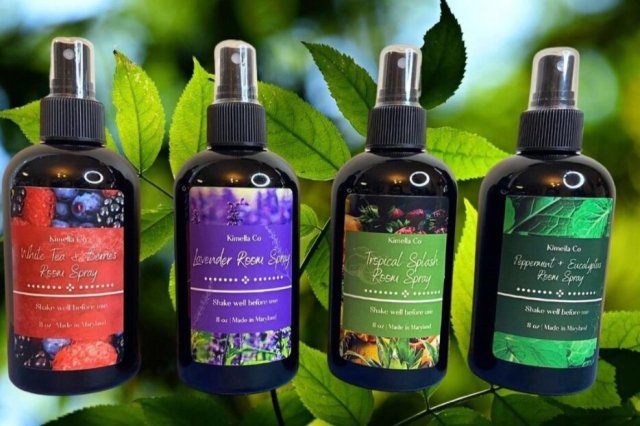
“Packed and produced with lots of love”, Kimberlee of Kimella Co wants buyers to know that each product she crafted has her feelings and yours in mind! From soy candles, corrosion-resistant earrings, natural and phthalates-free carpet fresheners and room sprays, and custom-made refillable lighters, Kimella Co is the business that handles health, wellness, and harmless, cruelty-free creation with high regards!
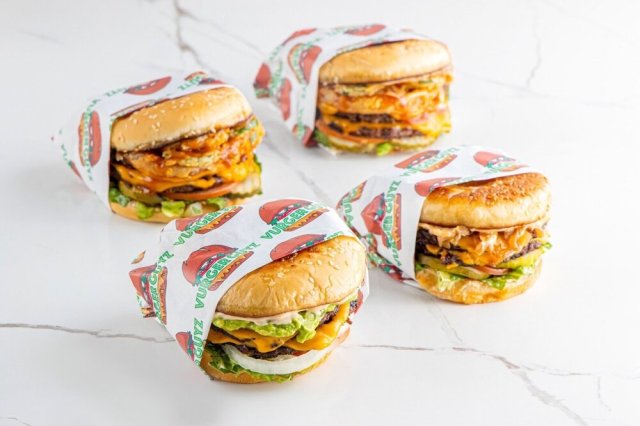
Nothing makes street life in downtown LA more exciting than enjoying street food. Now the excitement doubles when you can enjoy vegan street food made by four former NCAA athletes! Vurger Guyz is a food truck eatery, specializing in vegan burgers (called “vurgers”) and tacos, cooked in avocado and rice bran oils for your nutritional enjoyment. A space for vegans, this establishment welcomes newcomers into the herbivorous haven with their spin on typical street food, to let newcomers know that they’re not missing out on tasty treats when transitioning to this lifestyle. In fact, the business has a “one bite” policy, where if you take a bite and don’t enjoy it, the meal is on the house (or truck, in this case). However, after you take one bite of a “Smoky Sunset”, “Santa Fe”, or “Sunrise” vurger, you’ll definitely won’t leave a morsel of their veggie burger masterpieces!
“Born from adversity, cultivating unity” Jack Karuletwa produces coffee at his Los Angeles coffee shop using an eco-friendly smart roaster, and coffee beans from his home country, Rwanda. With each cup, his goal is to protect and uplift Rwandan farmers and their natural resources, as well as preserve the endangered species native to Rwanda: the silverback gorilla. When coffee connoisseurs purchase a Rwanda Morning Light, Rwanda Distinctive Dark, or a Decaf, a portion of that purchase goes to organizations such as Gorilla Doctors and Foundation Rwanda, to help the wildlife, the environment, and the people of Rwanda. If you need a healthy, coffee blend, Silverback Coffee of Rwanda is worth the spend!
For our readers with a sweet tooth, this vegan bakery business in New York City is the spot for your confection cravings! Given these are sweets, you may gain a pound or two; but if you’re not vegan, you’ll also gain a new, delicious perspective on desserts not made with animal-based products (cow milk, butter, eggs, etc.). If you live in the New York area, you can find their snickerdoodles, Banana Chocolate Walnut Bundt cake, and many other desserts in other black-owned businesses such as Brooklyn Tea, and Greedi Kitchen. Do not fret if you don’t live in the Big Apple, for the bakery ships out cake jars and cookies throughout the United States!
The Garden State is home to many treats such as Atlantic City and the Real Housewives of New Jersey; but, it’s also home to a shop that sells goodies that will stimulate the sweet part of your taste buds! Mo’Pweeze is a family-run bakery that not only produces vegan and kosher sweets, but sweets that are free of various allergens, such as dairy, gluten, nuts, shellfish, etc. The purpose of this bakery is to provide a flavorful experience to those with food allergies and other dietary requirements, as well as showcase that food without the typical ingredients can be just as palatable. One bite of their gluten-free banana apple bread, their mango habanero cauliflower wings, and their vegan-certified Hamentashen, you will definitely return and ask “more, please!”
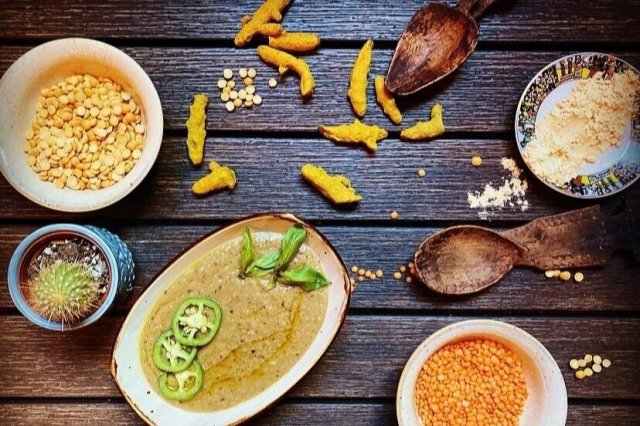
In a town that’s considered the melting pot of cultures, Ras Plant Based finds itself fusing traditional, Eithiopian culture with New York City and vegan culture in the form of a restaurant. Recipes handed down from generation to generation, Romeo and Milka Regalli interpret and produce wonderful, Eithiopian dishes, such as tibs, injera, and kitfo, but make it suitable for a vegan diet, and with the flare of the concrete jungle that is NYC. For a plant-based paradise in your mouth, and an authentic Eithopian ambience from foods, restaurant decor, and the dishes being named after places and nobility titles in Ethiopia, this eatery is the spot for you!
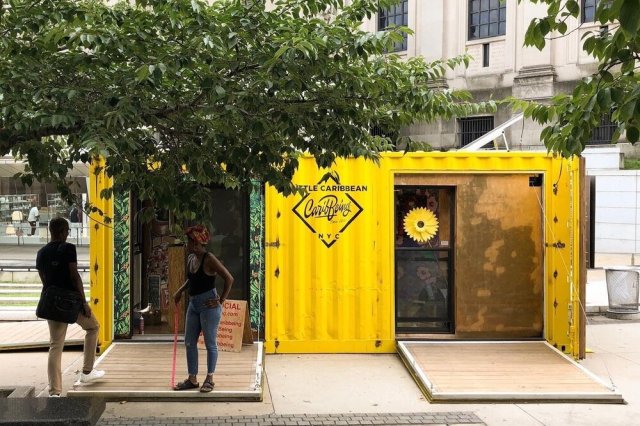
Located in the Little Caribbean region of Flatbush, New York City, CaribBeing’s goal is to uplift the Caribbean community in New York. Through various events (pop-up shops; art exhibitions), and various collaborations (local museums; Lyft; AirBnB), step by step, the community is getting stronger! What can you do to support, you ask? If you can’t attend the shops or the CaribBeing house, you can buy their various clothing merchandise that are hand-stitched by the Little Caribbean locals, so that every dollar is able to strengthen the community and allow everyone to prosper!
Want to learn about life in the Big Easy through the Black lens? Mikhala Iversen Afropean has arrived with her All About Dat Tours in New Orleans, Louisiana. Through spoken word and jazz music, Mikhala wants to give guests a history lesson about the Black experience in Louisiana that many other tours would often glamorize or tone down the harsh realities of what many Black people endured. When not discussing their plight, Mikhala also showcases the prosperity of the Black, Louisiana locals via the various Black-owned shops and eateries you’ll see throughout the tour. Due to the current times (COVID-19) there are a limited number of tours and spots to attend said tours in order to be health-conscious; therefore, it’s best to secure a spot for a one-of-a-kind experience swiftly!
meet the author
Rj Ross
Rj Ross is a writer at ecomadic. With his BA in communications and love for creative writing, he hopes to inspire and inform many generations about sustainable living and responsible traveling.
Bolsonaro’s – current president of Brazil – administration sovereignty claims on the Amazon rainforest have caused major setbacks in the battle against deforestation. Meanwhile the international community can barely intervene. At a time when climate change has become an issue of maximum urgency, we’re all witnesses of “the lungs of the planet” being destroyed irrevocably. The Amazon rainforest made its way to the media’s spotlight during the summer of 2019 due to the raging wildfires that caused extreme damage to the flora and fauna of the area. Societies have seemingly forgotten about it since then, but deforestation is a crucial issue to be discussed now and always. And no, it hasn’t gotten any better.
The Importance of the Amazon Rainforest
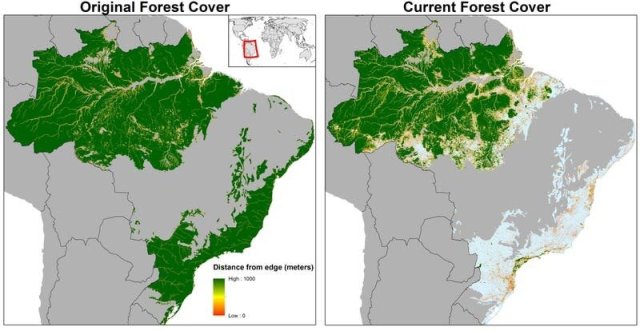
The Amazon constitutes around 44% of the South American continent. Although most of the forest is located in Brazil, it extends among seven other states: Bolivia, Colombia, Ecuador, Guyana, Peru, Venezuela, and Suriname; making these countries “the Amazon States”.
It holds the title of the largest freshwater reserve and forest to cover the planet, hosts an immense variety of flora and fauna, and is home to around 400 indigenous populations. Additionally, it is an exceptional field for scientific research and a fundamental source of food, materials, and medicines for its inhabitants.
But its most crucial role is maintaining the planet’s biodiversity. The Amazon works to support regional hydrology, acts as a terrestrial carbon storage space, and plays a large role in regulating the global temperature.
A Little Background on Deforestation
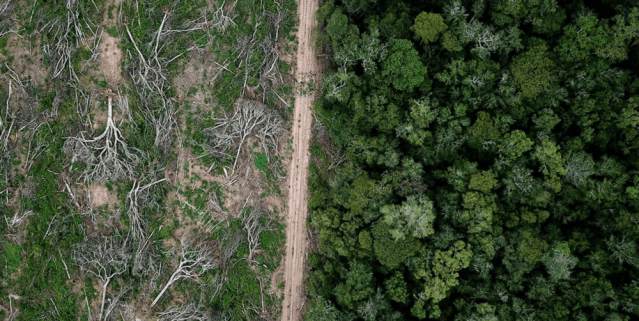
The Brazilian Amazon has the world’s highest rate of deforestation in the world, averaging millions of hectares per year. Historically the main cause of deforestation has been agriculture for local consumption. But by the 2000s more than three-quarters of forest clearing in the Amazon has been for cattle-ranching – responsible for the release of 340 million tons of carbon to the atmosphere every year. Furthermore, cattle pastures increase the risk of fire, cause significant harm to aquatic ecosystems, and perpetuate soil erosion, river siltation and contamination with organic matter.
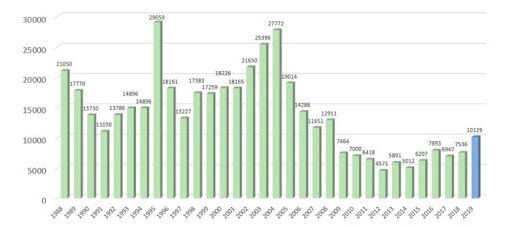
In 2004, the Brazilian environmental institute created the project DETER, which is an alert system aimed to keep track of deforestation in the Amazon through live satellite imagery. The reported data shows that the amount of deforestation through the years strictly depends on the political administration of the period taken into consideration.
PRODES annual consolidated deforestation rates (in km 2) since 1988 in the Brazilian Legal Amazon.
As seen above, the stunning results achieved by former Environment Minister Marina Silva from 2004 until 2016, have been almost nullified by the last two presidencies: Temer (2016-2019) and Bolsonaro (2019-present day). The data on deforestation shows a complessive decline of 64% between 2004 and 2018, and a dizzying increase of 37% only between 2018 and 2019.
Additionally, a decree issued by the current president Jair Bolsonaro has mostly eliminated the fines imposed by the Brazilian institute for the environment and natural resources (IBAMA), which means that the president of Brazil has explicitly paved the way for illegal deforestation and environmental violation.
What’s Happening During Bolsonaro’s Administration?
Brazilian president Jair Bolsonaro took office in 2019. His stand regarding the topic of the Amazon can be summarized in his opening speech during the 74th General Assembly of the United Nations regarding the recent 2019 events where the rainforest was seen all over the media due to wildfires and significantdeforestation. He affirms the following:
“It is a fallacy to say that the Amazon is the heritage of humankind, and a misconception, as confirmed by scientists, to say that our Amazonian forests are the lungs of the world. Using these fallacies, certain countries instead of helping, embarked on the media lies and behaved in a disrespectful manner and with a colonialist spirit. They even called into question that which we hold as the most sacred value: our own sovereignty”.
In other words: he believes that any scientific data on deforestation is a lie, and his sovereignty right over the rainforest is far more important than the preservation of humankind, which the Amazon is greatly accountable for.
Additionally, while wildfires are common in this region, satellite data from 2019 (the same year Bolsonaro took office) has shown an 84% increase in fires than from previous years. Many of these fires are started deliberately to make room for cattle ranching, and then spread uncontrollably causing enormous damage. Other than the obvious consequence of forest destruction, wildfires cause the release of the carbon stored within the trees, which has a direct impact on climate change. These disastrous developments have also negatively impacted the international relations between Brazil and other countries. One of the most relevant examples is Norway’s choice to suspend the transfer of R$100 million, which was aimed to protect the development of the rainforest.
Deforestation in the Bolivian Amazon for soybeans. 📷 Rhett A. Butler
Common Heritage of Humankind and the Role of the International Community
So if the Amazon is so important to all of us, how come all we can do is watch impotently while all this happens?
There’s a very simple explanation: sovereignty. All natural resources within the national territory of a country fall under its jurisdiction and administration. So the Amazon legally belongs to the States in which it is located (mainly Brazil).
According to the Brazilian Constitution of 1988, in fact, the Amazon Forest is part of the national patrimony and its various resources have to be exploited within the law, assuring the preservation of the environment. The fact that it is considered part of the national patrimony, points to the reluctance of the country to give up, in any circumstance, its sovereignty rights over the territory; so the truthful meaning of “preservation of the environment” is really up to the national political administration… and I think we can all see by now how that’s developing.
The international community could hold claim of the Amazon and administrate its preservation if it were considered “Common Heritage of Humankind”. Meaning that, “certain global commons or elements regarded as beneficial to humanity as a whole should not be unilaterally exploited by individual states or their nationals, nor by corporations or other entities, but rather should be exploited under some sort of international arrangement or regime for the benefit of mankind as a whole”.
Unfortunately, legally speaking, that’s not the case of the Amazon, because this notion exclusively applies to resources outside of any country’s territory, for example the Moon or the high seas. The document “Our Own Agenda”, formulated in 1990, affirms that the Amazon cannot be considered exclusively an “ecological treasure” and the regulator of global climate, because it is also a resource that facilitates the developments of the states in which it is located. The Amazon States are indeed convinced that:
“Preservation of the Amazon is of interest to the world community. However, it is of great interest to the Amazonian countries. The issues must therefore be debated by them on their own terms with the support of foreign scientists and enlightened international public opinion”.
The sovereign States’ obstinacy in reaffirming their authority over the Amazon territory, and underlining its economic value, makes the concept of common heritage of humankind inapplicable.
The Future of the Amazon
The main connection between cattle-ranching and deforestation is the production of soy, and Brazil is the world’s biggest supplier. Around 80% of the global soy production is destined to feed the animals, which then go through the industrial farming process.
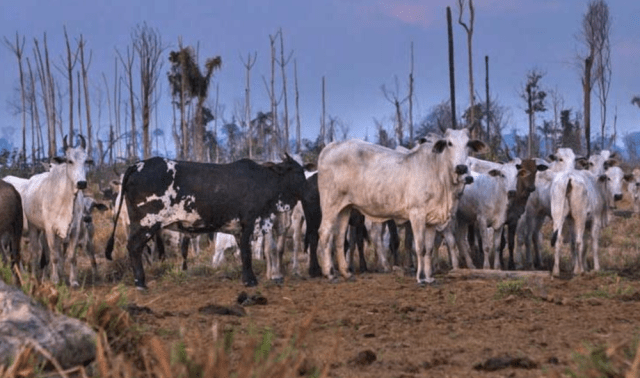
Cows grazing on recently deforested rainforest land in Brazil. 📷: Marcio Isensee, Mongabay
Timidly trying to do some damage control, some governments have already started to implement regulations to only import sustainably-sourced soya. The problem is that there is no internationally-agreed definition of responsibly- or sustainably-sourced soya, so only private certification schemes can provide some kind of parameter. For example, the Roundtable on Responsible Soy states that sustainably sourced soya guarantees zero deforestation and zero conversion. But is that enough?
Anna Jones, head of forests at Greenpeace, states that “the only way supermarkets and fast food companies will actually achieve deforestation-free supply chains is by reducing the amount of meat they sell, not by replacing soya with other feeds, or by paying certification schemes”.
So there you have it, the solution to drastically reduce the levels of deforestation… and CO2 emissions… and species threatened by extinction… and loss of biodiversity… and water waste… and the spread of zoological viruses that can potentially cause a pandemic or even the extinction of humankind: stop eating meat.
Giuliana was born and raised in Sicily (an Italian island in the middle of the Mediterranean Sea), since then she’s been moving around the world to meet new cultures and discover new places. She has a degree in Political, Social and International Sciences. During her studies she became passionate about environmental protection, gender equality, and cultural identity. She loves traveling, petting dogs on the street, and swimming underwater.
In the United States, a large portion of our annual budget is dedicated to the production and distribution of food. Specifically, 10% of the nation’s energy budget, 50% of its land, and 80% of all US freshwater consumption is committed to the agriculture industry. One would think that because so many resources and financial efforts go into the production of food, wasting even a pound would be a sin. Sadly, that’s hardly the case. Nearly 40% of food produced in the United States goes right to the landfill. Fortunately, composting is a method to combat food waste heading to the landfill – where it is unable to reach its full potential and further pollute our air and land.
Many people have taken up backyard composting and create nutrient rich soil from their food scraps. This practice is easiest accomplished if you are stationary and have access to a compost area that you know will be there every day, not while traveling! The handbook for composting doesn’t end there. Responsibly disposing of your food waste while traveling is definitely feasible, and can be done by just about anyone. Depending on how far and long you will be on the road, and what your geographic location is, an option for any situation is attainable.
Bring Your Compost Home
One of the most definitive ways to know your compost will be disposed of properly, is to bring it home! This is easiest if you are taking a road trip and will inevitably end up back home where your already forming compost is waiting for you.
Firstly, you will need to determine how long you will be gone for, and then pick a container that will be the appropriate size to hold all your food scraps. For longer expeditions, a five gallon bucket could work perfectly – they conceal the smell with the tightly fitted lid and you don’t have to look at any of it! If you aren’t planning on being away from the homestead for too long, then a large container (again, something with a tight fitting lid) will do the job. My preference is to use one of my many “stasher bags”.
These unique, extremely durable, reusable bags are an alternative to single-use plastic bags, and they can be reused indefinitely. These bags morph to whatever position you need them to fit in, and don’t take up much space – which is why I love using them to store my food scraps and used napkins. Whichever method works best for you, composting while on road trips is a completely achievable goal.
City Compost Program
Many cities across the globe have adopted some type of composting system. In forward thinking, advanced cities like San Francisco, seeing a compost bin is as common as seeing a regular trash can. Austin and New York both have a curbside program including multiple drop off locations throughout the cities.
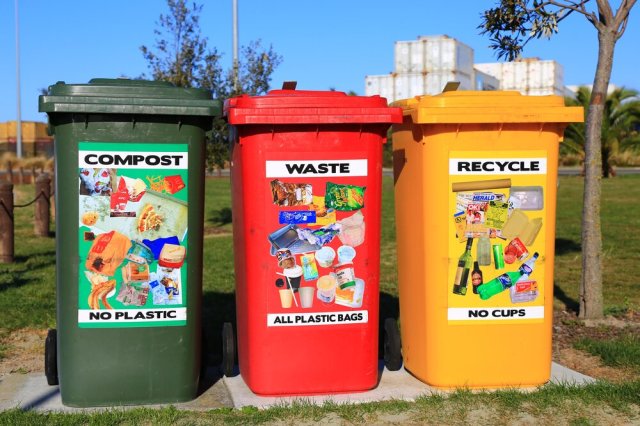
Across the pond where lifestyles may seem otherworldly different, the same initiatives take place in cities on a different continent. London may be fashionably late to the composting party, however, they are heading on track with other urban areas. A component we are faced with when given the options of recycle, compost, and landfill bins, are which items go in which bins.
📷 @splashabout
Many of us want to do the right thing but aren’t sure what is and what is not allowed. General rule of thumb for recycling bins is nothing too small or flimsy (plastic film) – plastic wrap, bags, and lots of plastic packaging. These items often complicate things in the factory, posing even dangerous outcomes.
For composting, there are a few more things to remember. If you’re collecting your scraps in a bag, make sure that bag is compostable and not a generic one from the grocery store. Other than food containing excess amounts of animal products or grease, most can be put into the compost bin. Items that belong in the landfill bin seem to be neverending – styrofoam material (egg cartons, to-go products), plastic bags, and soiled food products.
The task may be daunting at first glance, thankfully we have the internet at our fingertips and are able to solve any predicament we are faced with. When larger cities take these initial steps to show a sustainable future is within arms length, smaller ones soon follow. A chain reaction is created and soon the new norm will be for every metropolitan area and town to have composting sites as part of the infrastructure.
Local Food Stores or Coffee Shops
Whole Foods – a grocery store widely known across the United States with some locations in Canada and the United Kingdom – provides the opportunity for both employees and customers to compost their food scraps by providing bins in their cafe section. If only all large chain grocery stores could follow in the footsteps of Whole Foods.
Furthermore, typically, retail composting is done on a smaller scale. Think: family-owned businesses. Once you know what your travel destination is going to be, a quick Google search (i.e. ‘Local Co-Op’) can help you determine if this option would work well for you.
Community Composting Initiatives
Many communities have adopted composting programs, allowing their residents to take part in combating food waste. Through local farmers markets, community gardens, and co-ops – people who may not have access to convenient backyard composting, are suddenly able to participate and do their part. By gifting your nutrient rich food scraps to the local inhabitants you are ensuring that your valuable waste will be used properly and aid toward agricultural sustainability of the area you are in.
Bury it!
📷 @markusspiske
Certainly easiest to practice while in the wilderness, nevertheless, an unquestionable method to guarantee your food scraps end up back where they came from.
First, choose an area away from homes and communities, and make sure no meat and dairy products or small, pesky plastic items end up in your soon-to-be-composting pile. Next, dig a hole at least one foot deep and dump your collection of food waste into that hole. And the job is done!
While we’re on the topic of food and dirt, a habit to break away from is throwing a banana peel or apple core out the car window thinking it will break down. Eventually, these materials will break down. Though the collection of food waste on the side of highways proves to hold many issues. Depending on what environment you dump your food scraps, they could potentially take years to break down. What’s even worse, some animals may form a habit of looking for food near busy highways, putting them at a higher chance of being hit by a car. Many of the “natural” items we are carelessly disposing of, are not native to the environment they are now in. Meaning that the wildlife eventually eating these scraps, cannot break them down properly because they are not accustomed. Lastly, nobody wants to see food littered throughout what should be pristine nature.
If you’re going to toss your leftovers outside, make sure they are put in a hole and covered. A little more hands on, however, still satisfying knowing your pits and peels will soon be breaking down to nutritious soil.
Compost Networking Service
Though far and few currently, some online compost locating services are available. Simple as typing in your current location, and having the convenience of the internet do all the hard work for you. Depending on what service you are using, drop off locations could vary from stores, farmers markets, or individuals collecting from neighbors. ShareWaste is an incredible platform that connects people who possess food scraps but lack the environment to dispose of properly to local individuals in their community that willingly accept compostable items. This is accessible to nearly anyone in this day and age – an easy download in the app store, or a search in the browser of your computer. Typing in your postal code, and quickly realizing you will never have a problem trying to compost on your travels ever again. Zooming out, and scanning across the globe, every continent is flooded with people who are eager to accept your cucumber peels and old oatmeal. ShareWaste shows that there is a solution to the food waste crisis currently underway.
The Big Picture of Tourism & Composting
Before taking the time to research whether or not composting while on the road was realistic, I was on the same boat as everyone else and dumped my food waste in the bin to be sent to landfill. While knowing the tourism industry significantly impacts the environment and climate, the topic is generally overlooked. When looking at the big picture, it can be hard to imagine that one person can do much to help the situation. But if you begin to imagine the monumental impact that could be if the hundreds of thousands traveling each year did their part to lower their carbon footprint, the small habit of composting could effectively offset some of the harm we have caused. Being a sustainable traveler is possible in today’s world.The resources are available, we just have to want the change.
meet the author
Kristen McKenna
Kristen was born and raised on Long Island, New York. After spending her childhood and teenage years exploring New England, she is now ready to see what else the world has to offer. Through her blog Tip Toe the Globe, she hopes to share her intimate adventures while at the same time spread awareness of environmental sustainability and lower waste living. If you can’t find her on a hike, she’s probably looking for a bakery or ice cream shop.
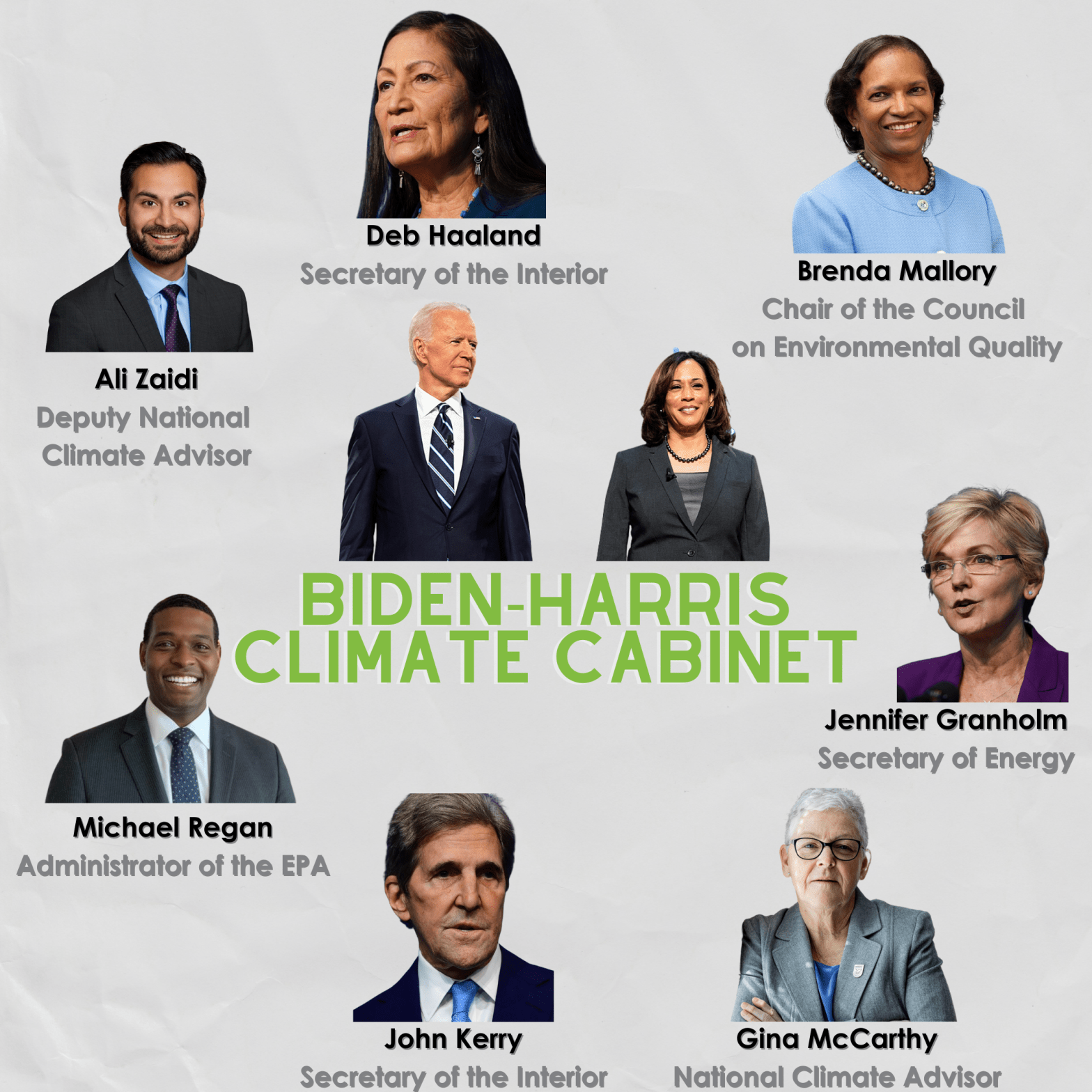
An essential aspect of holding our government accountable regarding climate change is to familiarize ourselves with those in positions of power who will implement consequential environmental policies and legislation. Because Biden’s “Climate Cabinet” will have a significant hand in shaping future environmental regulations, we have compiled a run-down of their positions, experiences and commitments in order to make it easier to hold the administration to their promises.
Brenda Mallory
“It is essential that we deploy smart and humane policy to help communities pull themselves back from the edge and improve the health, security and prosperity of all people.”
Position: Chair of the Council on Environmental Quality (CEQ)
Description: The CEQ conducts environmental reviews for almost all major infrastructure projects on the federal level.
Commitments:
– Center environmental justice within the CEQ
– Overcome the legacies of environmental impacts and catastrophes
– Tackle the full range of climate change
Experience:
– Director of Regulatory Policy for the Southern Environmental Law Center
– Executive Director and Senior Counsel for the Conservation Litigation Project
– General Counsel for the White House Council on Environmental Quality
– Acting General Counsel and the Principal Deputy General Counsel at the U.S. Environmental Protection Agency
Ali Zaidi
“We need a whole-of-government approach to take on the climate crisis — in a way that spurs jobs and advances justice.”
Position: Deputy National Climate Advisor
Description: Coordinate climate change work across the White House and federal agencies.
Commitments:
– Protecting the planet and those already experiencing the devastating effects of climate change
– Creating union jobs and building new green industries
Experience:
– Deputy Secretary for Energy and Environment for New York state.
– Associate Director for Natural Resources, Energy, and Science at the White House -Office of Management and Budget (Obama Administration)
– Deputy Director of Energy Policy for the White House Domestic Policy Council (Obama Administration)
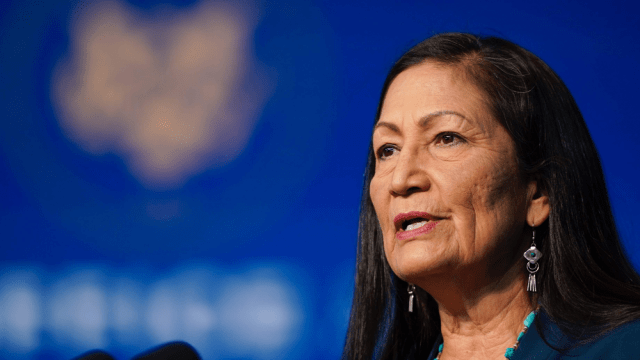
Deb Haaland
“I’ll be fierce for all of us, for our planet and all of our protected land, and I’m honored and ready to serve.”
Position: Secretary of the Interior
Description: Management and conservation of federal land and natural resources. Lead the Bureau of Land Management, the U.S. Geological Survey, Bureau of Indian Affairs (hate this name), and the National Park Service.
Commitments:
– Promote clean energy and protect public lands
– Closing the racial, wealth, and health gaps
– Creating good jobs
Experience:
– Vice Chair of the House Committee for Natural Resources
– Head of New Mexico’s Democratic Party
Jennifer Granholm
“We can win those jobs for American workers with the right policy. We can, and I know what those jobs will mean for both the planet and for those workers and families.”
Position: Secretary of Energy
Description: Developing technology and policy for efficient energy
Commitments:
– Creating jobs in states with a history of fossil fuel production
– Spoke out against both Keystone XL and Dakota Access pipelines wants divestment from fossil fuels
– Supporting the 17 National Labs and other facilities in research on climate change and emissions
Experience:
– Former Michigan Governor during Great Recession
– Attorney General of Michigan
Michael Regan
“And as a state official, I understand how actions from EPA can help or hurt local efforts. We’re going to ensure that EPA is once again a strong partner for the states, not a roadblock.”
Position: Administrator of the Environmental Protection Agency (EPA)
Description: Enforcing environmental policies
Commitments:
– Environmental Justice
– Conservation of natural resources and improving air and water quality
– Help and protect communities while helping them achieve a cleaner world
Experience:
– Head of the North Carolina Department of Environmental Quality
– National program manager for the Office of Air Quality Planning and Standards (Clinton Administration)
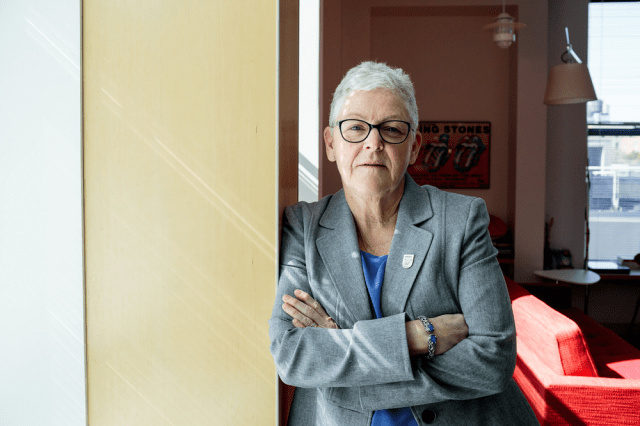
Gina McCarthy
“My goal is to marshal our entire government, engage every community, harness the forces of science and the values of environmental justice – all to build a healthier and more just world.”
Position: National Climate Advisor
Description: Chief advisor to the president on domestic climate change policy, and head of the White House Office of Domestic Climate Policy.
Commitments:
– Investment into environmental justice communities
– Clean energy infrastructure and unionized green energy jobs
– Preserving biodiversity and natural resources
Experience:
– Former President and CEO of NRDC (Natural Resources Defense Council)
– 13th Administrator of the EPA
– 2015 – Signed the Clean Power Plan, set the first national standards for reducing carbon emissions from power plants.
John Kerry
“Success means tapping into the best of our collective ingenuity, creativity, and diplomacy, from brain power to alternative energy power, using every tool we have to get where we need to go. Success means lifting up communities long left behind and creating an equitable recovery.”
Position: Special Envoy for Climate
Description: Will sit on the National Security Council, and influence important decisions about foreign affairs and national security in relation to climate change.
Commitments:
– Re-establish the U.S. as the global leader on climate change and climate diplomacy
– Global reduction of carbon emissions
– Hold Biden’s promised virtual global climate summit within the first 100 days
Experience:
– 68th United States Secretary of State
– Lead negotiator for the Paris Agreement & Kigali Amendment to the Montreal Protocol
– Massachusetts Senator for 28 years
All of the cabinet members, except John Kerry, are awaiting Senate approval in the coming weeks.
meet the author
Josefina Artigas
Josefina is a content writer at ecomadic. They hold a BS in Biochemistry and a minor in sociology. Their interests include cooking, anime, and coding. They are passionate about the intersection of sustainability and social justice.
Few places in this world are more dangerous than home. fear not, therefore, to try the mountain passes. They will kill care, save you from deadly apathy. set you free, and call forth every faculty into rigorous enthusiastic action
– John Muir
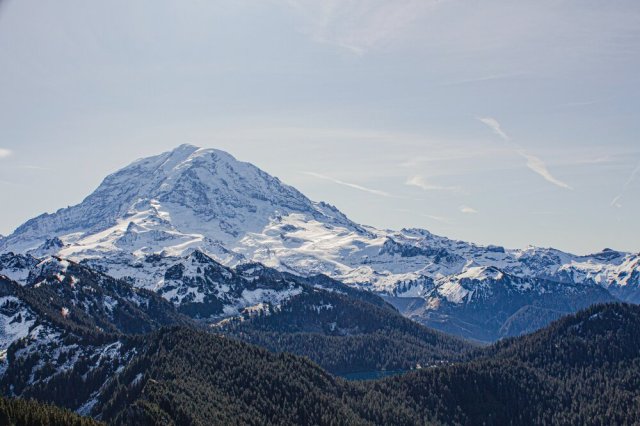
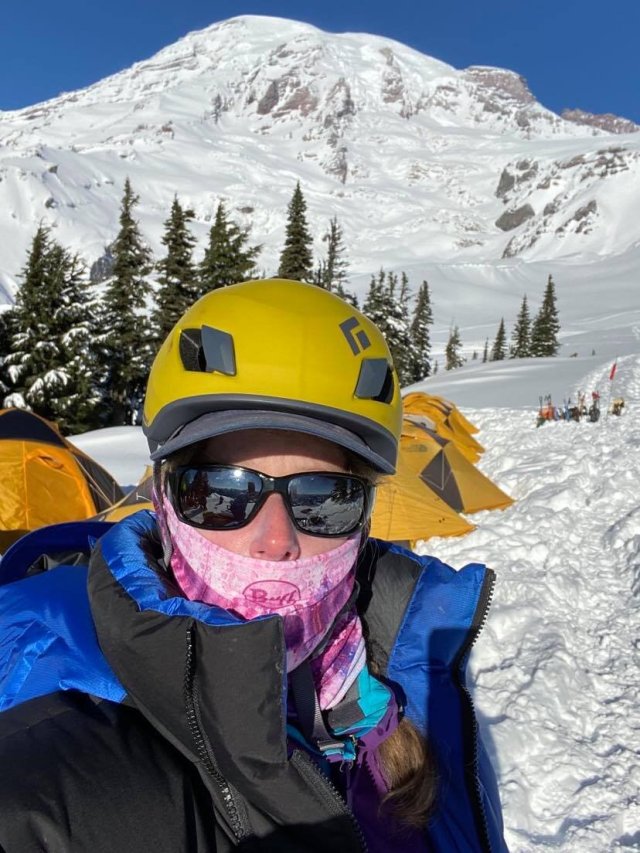
Standing 14,411 feet above sea level, Mt. Rainier is the highest volcanic peak in the state of Washington and the Cascade Range. On December 26th, 2020 Alpine enthusiast Susanna Funk began her climb of Mt. Rainier in Washington State with a small group of other climbers through the organization Alpine Ascents.
We caught up with her in between training for her next climb: the highest peak in North America: Denali (at around 20,000 feet above sea level in Alaska) and learned about some sustainable practices she and her team practiced during this challenging yet life changing experience.
Mount Rainier, Washington. 📷 @jonlampel
Q: Can you give us an overview of the trip?
I came to Rainier to train with a group of climbers who are planning to climb Denali in Alaska. Denali is the highest mountain in North America and stands at 20,308 feet above sea level. Climbing Denali requires a considerable amount of training and careful adaptation to safe mountaineering skills. Rainer has deep, wide crevasses and steep slopes that are great training grounds for Denali.
The minute I stepped foot onto the snow at the base of the mountain I knew I was in a special place. Most people climb Mt. Rainer in the summertime, but I planned this climb in the winter to acclimate my body to harsh winter mountaineering conditions.
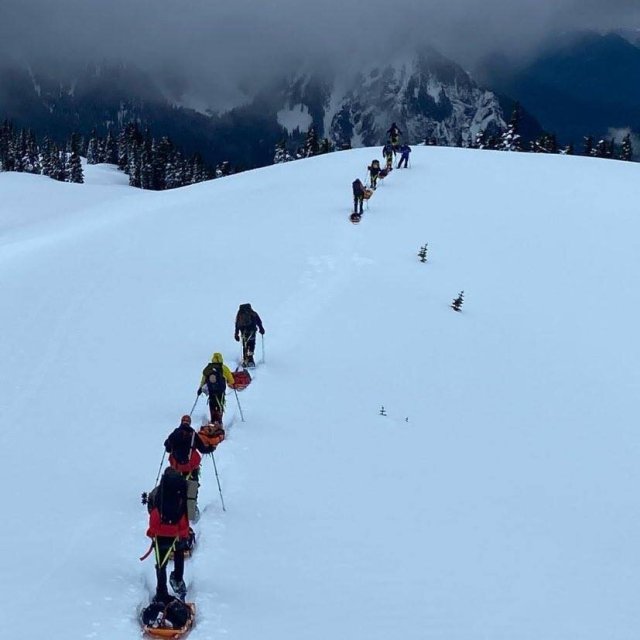
After my group of climbers established our first camp on the mountain, we spent the first few days training as a roped team, in crampons and ice axes. We performed crevasse rescues, practiced arm wrap rappelling, and built snow anchors under the direction of professional mountain guides.
Susanna Funk
Q: Did you run into any sort of unusual hardships? What was the temperature most days?
On the 4th day of the trip, we got caught in a snowstorm. Luckily, we were safely in our tents when it hit. It snowed two inches an hour. We had to get up in the middle of the night to shovel the snow off our tents so we wouldn’t get buried. This storm lasted for 3 days. This was hard work!
But, the storm gave us the opportunity to practice navigating as a roped team in a whiteout. Winds gusts up to 25/30 mph. The temperature was a moderate 32 degrees. Interestingly, Rainer can have humid weather patterns and temperatures can warm up when the snow starts.
Q: What kind of training did you do for this trip?
Training is almost as fun and climbing a mountain! Mountaineering requires physical strength and large aerobic capacity. I trained 10-15 hours a week for 6 months and up to 20 hours a week in the month before I left. My training included carrying a heavy pack and hiking for 4-6 hours uphill. I also pulled tires behind me to get strong legs. I completed fasted, easy running, lasting one hour or more. I didn’t go to the gym during the pandemic so all my training was outside or with free weights at home.
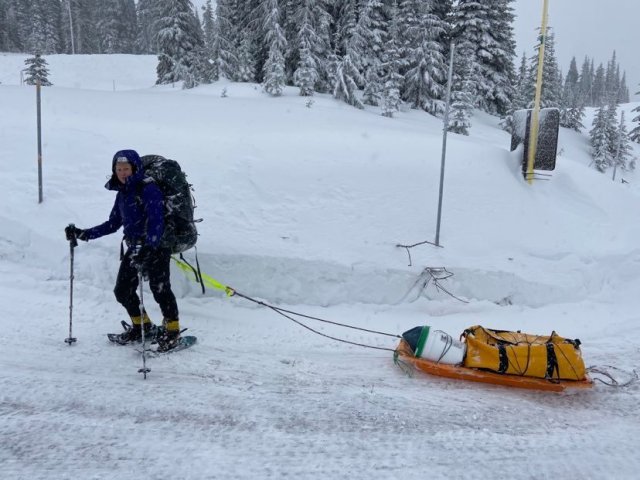
For reference, the expeditions on Denali last three weeks and you have to carry a heavy pack and pull a sled behind you with your gear and food. Most people carry and pull about 90-120 lbs. Since we were only on Rainier for a week, we carried less weight. The training plan said to be able to carry a 55 lb pack and pull a 25 lb sled behind me. That is almost 65% of my body weight, so that’s why I placed so much dedication to training.
Source: Susanna Funk
Q: ecomadicfocuses on “sustainability within traveling”. What comes to your mind regarding your adventure – in terms of sustainability?
Mountains are the water towers of the world. The snowfall melts in the spring and fresh-water rushes down the sides of the mountains to the rivers and streams below giving hydration to our soil, our vegetation, and providing the water we drink.
The glaciers on our mountains are fragile and global warming is causing them to shrink in size. We need to leave these beautiful pristine mountains as clean as they were when we come to them. An important part of being in the mountains is the commitment to leave no trace. This means not leaving any waste behind: this includes regular trash obviously but also human waste. Lol. We have an obligation to keep it clean. What about human waste? (I think it’s interesting to know!) Lol. We were so diligent to leave no trace that we didn’t leave anything behind even our human waste.
We used individual “CleanWaste GO Anywhere Toilet Kits”. These are waste bags otherwise known as “wag bags.” We dug a latrine within walking distance of camp and used this as a space to go for privacy when we needed to use the wag bag. Fortunately everything in the bag froze quickly so there was no smell!
Q: What is something that struck you about this trip?
What I like about endurance challenges is that you are moving on your own human power. There’s no elevator or machine to get you to the top. You are moving on the power of your own body. Food is your fuel source to give you energy to climb.
Mountaineering taught me to exert a sustainable amount of energy to keep a pace that I can maintain throughout the long days. On Denali, I will spend three weeks climbing the mountain and I will carry everything I need to sustain my body in my pack or in my sled.
Q: What do you learn from climbing mountains?
Mountaineering is hard manual labor. You have to pull a heavy sled and carry a pack uphill in deep snow. You have to dig out platforms in the snow to set up your tent, dig out the tents during snow storms and create snow walls. You have to melt snow to make water to drink and cook with. The cold and wind make everything harder. Sometimes it feels like it’s a battle for survival. It’s not for the faint of heart!
Mountains are powerful teachers. You can’t be arrogant. You are always at their mercy. Wind, storms, avalanches, crevasses, rock falls: these events could happen at any time. The mountain is always in charge. I don’t climb a mountain to conquer it. I climb it because I am in awe of it’s beauty and power.
Source: Susanna Funk
Q: Lastly, why do you climb mountains?
When I come to a mountain range and look up I can feel their power. It’s like a magnet. I’m drawn to them. When I’m high up on a ridge almost at the summit, I think about how lucky I am to be in this place and to see things that most people will never see. It takes all I have to climb.
The mountain will reward you with beautiful sunrises, sunsets, and views from the summit that you will never forget. We can learn to push our own mental and physical limitations in climbing a mountain. As several mountaineers will tell you, it’s about reaching the summit. It’s about the journey and what you learn about yourself along the way. If you are lucky, you can stand on the top of the world for a few minutes.
Sustainable Tips While Hiking or Climbing Mountains:
If you are not hiking local, obviously the burning of fossil fuels to travel to your trailhead is one of the big factors in making this trek in the first place. If you can, carpool or use public transportation as much as possible to get there. Once you are there, stay on the trail to avoid stomping on delicate ecosystems.
Watch your microtrash. As stated above, it is imperative to leave no trace. All those granola bar wrappers and even orange peels, which are biodegradable, take a long time to break down. And other travelers don’t need to see your trash or dispose of it for you. Take all of your trash out. Double and triple check your campsite when you leave.
Silicone camping dishes are a great find. Sea to Summit sells a complete set here.
A single use plastic water bottle is a relic of the past. Use this system from Lifestraw instead.
If you are doing an Alpine climb, every time you take a drink, pack a little show into your hydration system.
While going to the bathroom outside, all toilet paper and wipes need to leave with you. This Deuce of Spades handy trowel can help dig a small hole.
Choose brands that honor the bluesign label. This means no harsh chemicals were used from start to finish. Choose gear with customer friendly repair practices: Cotopaxi, Osprey, and Patagonia are three options.
meet the author
Jennifer MacBain-Stephens
Jennifer MacBain-Stephens went to NYU’s Tisch School of the Arts and now lives in Iowa where she likes to rock climb, hike, and mountain bike. She is the author of four poetry collections and enjoys exploring how to blend creativity with nurturing the earth. She also hosts a free, monthly reading series sponsored by Iowa City Poetry called Today You Are Perfect.
Every country can be beautiful in its way. Although Paris, Rome, Madrid, and England are among the countries with the highest tourist destination spots, these smaller countries are perfect for a sustainable traveler. With beaches, mountains, and lively cities, there are plenty of ways to get around on foot. And shopping locally is the best way to fully experience these decedent cultures and sceneries that lie beneath the surface of some of the wonders of the world.
In case you need some source of inspiration on where to take your next trip post-COVID, we have compiled a list.
Romania
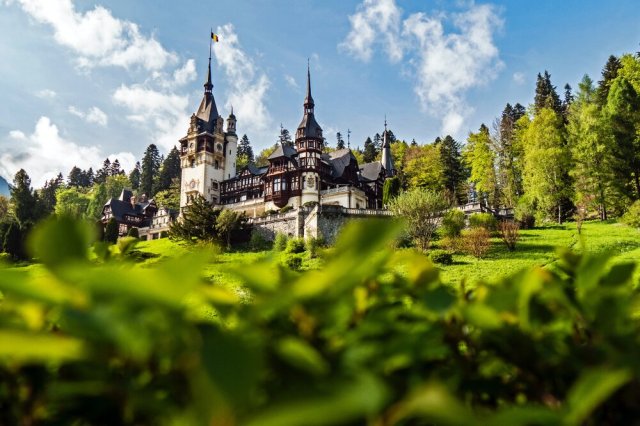
Peles Castle, Romania. 📷 @majklvelner
Known for its medieval towns and long-standing history, Romania is a country located in South-Eastern Europe. The country brings many attractions, but they are most prominently known for their historical use of cultivation to fuel the economy and variants of architectural designs.
Churches, synagogues, castles, and palaces are everywhere throughout the country and can date back to the 12th century. Bran Castle is one of Romania’s most iconic buildings. Located in Transylvania, Bran Castle is home to many vampire myths, including the infamous Count Dracula. Furthermore, with more than one-third of the land being devoted to agriculture, Romania is considered one of Europe’s major wine-producing countries.
Romania as a society is viewed by hierarchy. The elder people are viewed as being wise and are widely respected. Moreover, historically, the Romanian population value its traditions in folklore, and those traditions still remain strong in parts of the country. Such as Sarmale or cabbage rolls, which are a traditional Romanian dish served at gatherings made with minced meat, onions, rice, and various spices. This dish is also known for being a comfort food to many Romanians.
As more people begin to fill out their Eastern-Europe travel itineraries, Romania should be at the top of everyone’s list.
Cape Verde or the Republic of Cabo Verde is an island country off the coast of West Africa. Much like many African countries, Cape Verde houses much wildlife, including more than 100 known species of birds. Crioulo is among the oldest Portuguese Creole languages, and along with its dialects, it is the most widely spoken language in Cape Verde. You will find much corn, rice, beans, fish, and manioc, often referred to as cassava, as they are just a few staple foods on the island. Using the many staple foods, cachupa became the national dish of Cape Verde. With its many variants, cachupa is generally sold once a week around the islands, but this stew is worth waiting. As Cape Verde is home to many Islands within the country, the island of Sal is one of the most picturesque places you can visit. Often referred to as the sunniest island, Sal is where you’ll find golden beaches, deep waters, and a great adventure.
Singapore
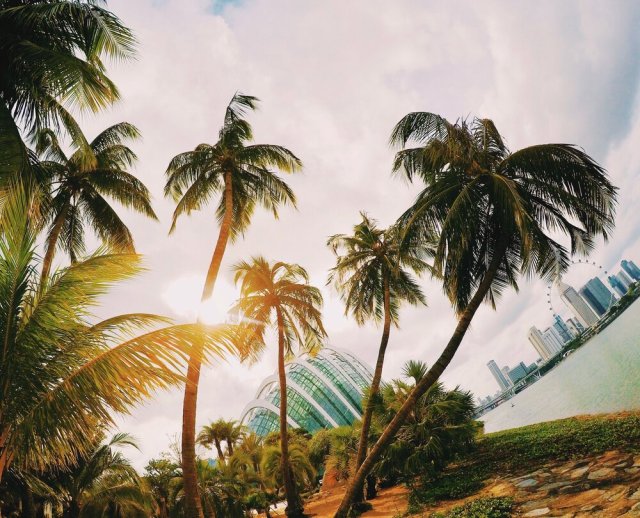
Gardens by the Bay, Singapore. 📷 @jaclynyost
Singapore is a city-state and one of the fastest-growing metropolis cities in the world. With a population of 5.6 million people, it is also the smallest country in Southeast Asia. Along with being one of the top fashion capitals in Asia and a global financial port, an article from the Independent News & Media ranks Singapore 24th as the world’s friendliest city. Due to its strict laws, Singapore has a low track record with street violence and is one of the world’s safest countries to visit.
Singapore was also labeled the world’s smartest city when looking at aspects of public safety, mobility, technology, and health. Merlion Park is one of Singapore’s most significant landmarks. The Merlion is a half fish, half-mythical lion creature that combines the two elements of Singapore’s identity. The fish represents the country’s past, while the lion represents the now.
In recent years, Singapore has been aiming to be the world’s greenest city. In Marina Bay, an area known for its skyscrapers and upscale malls, all of their developments comply with a 100% greenery replacement policy.
Although not everyone will be living the Crazy Rich Asians lifestyle, it is still a remarkable place to check out.
New Zealand
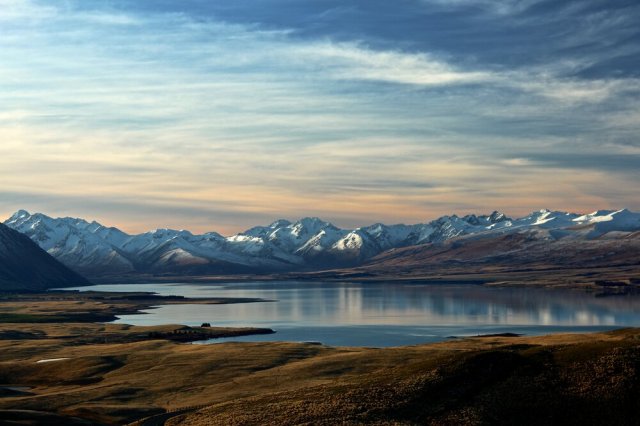
Lake Tekapo, New Zealand. 📷 @tokeller
Being one of the few countries in Oceania, New Zealand is an island country located in the southwestern Pacific Ocean. New Zealand is a place full of magic, and the landmarks that span across the world are no match for the natural beauties in NZ.
On the South Island, you will find Aoraki Mount Cook. This land is the highest mountain in NZ, with a height of 3,754 meters. And if climbing mountains isn’t your speed, there are various alpine paths and scenic routes for you to take near the local village.
NZ can’t be mentioned without shining light on its people. With a population of about 5 million, the rich cultures that reside on this island are exquisite. Māori people are members of the Polynesian people of New Zealand, and a Marae is the best way to learn about Maāori culture. The Maāori people must officially invite you to enter a Marae, and the traditional ceremony given by the Māori people consists of singing and dancing. This ceremony or powhiri is done to ensure that the visitors come in peace.
Morocco
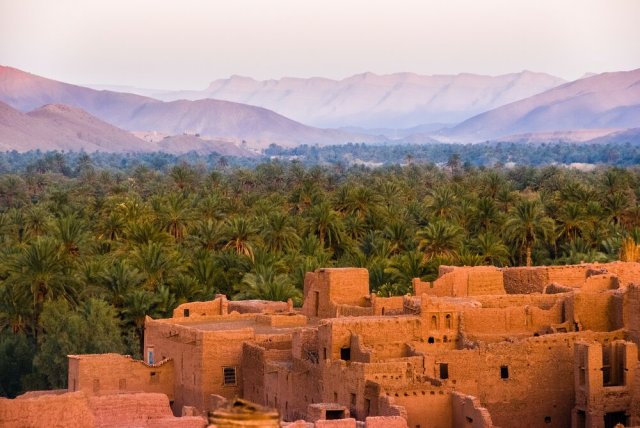
Tamnougalt, Morocco. 📷 @sickle
Morocco is a country that lies in western North Africa. Morocco’s unique architecture and designs have given the country its charm and lavish style for centuries. Many African tribes and Islamic traditions influence Moroccan design and architecture. Moroccan music festivals are a significant part of the country’s artistic experiences, and the Timitar Festival is often regarded as one of the premier festivals on the continent.
Much like many African countries, street food is a significant plus for tourists to try. To satisfy a sweet tooth, chebakia is a doughy pastry fried and then covered with syrup and sesame seeds. For something savory, harira is recommended by locals. This soup is thought of as the national dish of Morocco. With its blend of spices and vegetables, it is the perfect first dish to try.
Stepping Outside the Box
These five countries are just a few of many that should be experienced by everyone. And with their natural beaches, historic architecture, and preserved cultures, it is a wonder why these gems have gone overlooked by many travelers for so long. While it is nice to go on a European vacation to Paris or London you shouldn’t be so quick to overlook another wonder of the world.
meet the author
Raven Perkins Steele
Raven is currently a college student residing in Charlotte, NC. Her interests include traveling and exploring the world through different lenses. Having a passport from before the age of walking has instilled the value of different cultures as a part of her identity. She is passionate about spreading awareness on political and social issues in the United States and abroad.









































 ecomadic